Overview
- When does the Newton polytope prove absolute irreducibility?
- How are monomial factors detected?
- What can be concluded when the polytope decomposes?
Newton polytopes and products
For , its Newton polytope is
For a product, , where the right side is the Minkowski sum. For a linear weight with unique maxima on the two factor polytopes, the product of the highest-weight terms is nonzero and is the unique highest-weight term of the product. Varying the weight determines the polytope and proves the identity.
A lattice polytope is integrally indecomposable if every expression as a sum of two lattice polytopes has a point as one summand. A point polytope corresponds to a monomial, not necessarily to a constant.
References 1
- GaoLauder2001 · §2, Lemma 1 and Corollary 2Product formula, with its origin attributed to Ostrowski, and the monomial caveat.Source
The indecomposability criterion
Theorem (Newton-polytope criterion)
Let be nonconstant and divisible by no variable . If is integrally indecomposable, then is absolutely irreducible.
Any factorization over decomposes the same lattice polytope. One factor must therefore have point support and be a monomial. Since no variable divides , that factor is a nonzero constant. This excludes every nontrivial factorization.
The criterion depends only on the support. It remains valid after changing the nonzero coefficients, over any field, provided the support is unchanged.
References 2
- Gao2001PolytopesIntegral indecomposability criterion; the elementary proof is included.Source
- GaoLauder2001 · Corollary 2Explicit statement excluding divisibility by any variable.Source
Connections and evidence
PublishedHow can exponent geometry prove absolute irreducibility?
A polynomial factorization forces a Minkowski sum of lattice polytopes. If the support cannot decompose and monomial factors are excluded, no factorization survives over any field extension.
Scope. Let be any field and be nonconstant. Write for the convex hull of its exponent vectors.
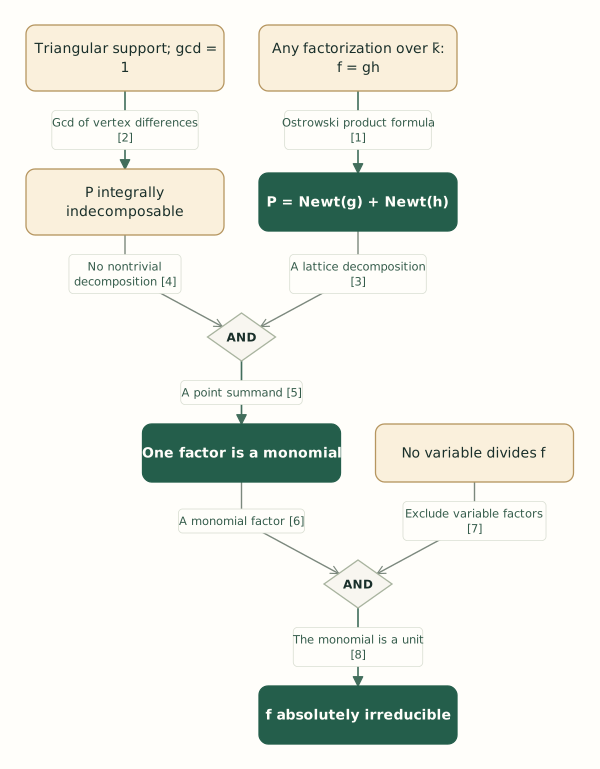
→ deduction or information flowAND joint hypotheses
A lattice polytope is integrally indecomposable if every Minkowski decomposition into lattice polytopes has a point as one summand. If has this property and no variable divides , then is absolutely irreducible. The diagram proves this over ; no characteristic restriction is needed. A nonzero constant term suffices to exclude variable divisors.
For a lattice triangle , indecomposability is equivalent to
For example, for every field and every ,
is absolutely irreducible: its vertices are , the extra exponent lies inside the triangle, and . More generally, arbitrary interior coefficients are allowed whenever the three vertex coefficients remain nonzero.
The arrow has no converse: a decomposable support may still carry an irreducible polynomial. Also, has an indecomposable translated triangle but is reducible; excluding monomial factors is essential.
Inspect all 8 connections and exact references
| Connection | Statement and source |
|---|---|
| 1Any factorization over k̄: f = gh → P = Newt(g) + Newt(h)Deduction | The Newton polytope of a product is the Minkowski sum of the factor polytopes, also over the algebraic closure.
|
| 2Triangular support; gcd = 1 → P integrally indecomposableDeduction | For a lattice triangle with vertices v₀,v₁,v₂, gcd of all coordinates of v₀−v₁ and v₀−v₂ equal to one implies integral indecomposability.
|
| 3P = Newt(g) + Newt(h) → ANDConstruction / input | Every hypothetical factorization supplies this decomposition of P. |
| 4P integrally indecomposable → ANDConstruction / input | Integral indecomposability forces a point summand in every such decomposition. |
| 5AND → One factor is a monomialDeduction | A point Newton polytope means that the corresponding nonzero factor has exactly one monomial.
|
| 6One factor is a monomial → ANDConstruction / input | This reduces every hypothetical factorization to one with a monomial factor. |
| 7No variable divides f → ANDConstruction / input | A nonconstant monomial divisor would contain at least one variable as a divisor. |
| 8AND → f absolutely irreducibleDeduction | Every factorization over the algebraic closure has a constant factor, which is exactly absolute irreducibility.
|
Sources and scope checked .
Example
Example
Consider over any field. Its Newton polygon has vertices . The oriented edge vectors are , all primitive integer vectors.
A nontrivial Minkowski summand of a triangle must itself be a triangle with parallel corresponding edges; a segment summand would introduce another edge direction. The two triangular summands would therefore divide each edge into two positive integral lengths. A primitive edge has lattice length one, so this is impossible. The polygon is integrally indecomposable. The nonzero constant term excludes nonconstant monomial factors. The criterion therefore proves absolute irreducibility in every characteristic.
References 1
- Gao2001PolytopesTriangle indecomposability criteria; this particular support is checked explicitly here.Source
Limitations
Monomial factors. The polynomial has a translated indecomposable triangle as its Newton polygon, but has a nonconstant monomial factor. The hypothesis excluding variable divisors is essential.
The converse is false. Over a field of characteristic different from two, is absolutely irreducible, although its polygon is twice the standard simplex and hence decomposable. Its projective homogenization is nonsingular; a reducible projective conic over an algebraically closed field is a pair of lines, possibly repeated, and is singular. In characteristic two this example becomes , so the characteristic restriction is necessary.
References 1
- GaoLauder2001 · §5A decomposable polytope makes the shape test inconclusive; the examples are direct checks.Source
Laurent polynomials and changes of exponents
In the Laurent polynomial ring , every nonzero scalar times a monomial is a unit. Thus the polytope criterion has a simpler form: a Laurent polynomial with at least two terms and an integrally indecomposable Newton polytope is absolutely irreducible in the Laurent ring.
A matrix in defines an invertible monomial substitution. It preserves Laurent irreducibility and takes Newton polytopes to their images under the corresponding lattice map. For ordinary polynomials, any common monomial factor must be removed separately.
Example
The polynomial , with and , is absolutely irreducible exactly when . If the gcd is one, a lattice change sends its exponent vector to . If the gcd is , it is , which factors over , possibly with repeated factors.
References 1
- GaoLauder2001 · §2, lattice polytopes and polynomial factorsSource
When the polytope decomposes
A possible Minkowski decomposition is a necessary condition on the supports of two factors. The coefficients must still satisfy their product equations. Thus the polytope can rule out a factorization without solving for any coefficients, but a decomposition does not construct factors.
For example, and have the same square Newton polygon over . The first factors. The second is absolutely irreducible: as a polynomial in , it is , and these two coefficients are coprime even over .
When the polygon has few possible summands, its geometry can also reduce the work needed by a factorization algorithm. Weimann’s published 2025 method uses such information under explicit nondegeneracy and characteristic assumptions.
References 2
- GaoLauder2001 · §5Source
- Weimann2025ConvexDense · Definition 1.1 and Theorem 1.2Source
Related topics
Polynomials in several variables
Gauss’s lemma and linear-variable tests complement the support test.
Related toNewton polygons and Galois groups
Valuation polygons use coefficient valuations; these polytopes use exponent support.
Related toFactorization in several variables
Polytope constraints can reduce lifting and recombination work.
References
- Decomposition of Polytopes and Polynomials
Gao, Shuhong and Lauder, Alan G. B. Discrete & Computational Geometry, 26(1), 89–104, 2001.
Read the source - Absolute irreducibility of polynomials via Newton polytopes
Gao, Shuhong. Journal of Algebra, 237(2), 501–520, 2001.
Read the source - Improvements of convex-dense factorization of bivariate polynomials
Weimann, Martin. Polynesian Journal of Mathematics, 2(4), 1–34, 2025.
Read the source
Comments
Any comments are welcome. Comments appear after the site owner approves them. Privacy policy.