Overview
- How does an irreducible polynomial define a field extension?
- How do irreducible factors correspond to Galois orbits?
- What does the Galois group tell us about an equation?
- How are these questions related to finite fields, local fields, and polynomial families?
From equations to fields
To study a polynomial, one first chooses its coefficient field. One then asks whether it factors, which field contains its roots, and which permutations of the roots preserve their algebraic relations. These questions lead from polynomial arithmetic to field extensions and Galois groups.
Consider . It has no rational root, so it is irreducible over . Adjoining its real root gives a field of degree three. To obtain all three roots, one must also adjoin a primitive cube root of unity. The resulting field has degree six, and its automorphisms realize all six permutations of the roots. Irreducibility, the degree of a field generated by one root, and the Galois group describe different parts of this example.
This article gives an overview. Field extensions develops the construction and arithmetic of fields generated by roots. The Galois correspondence explains how subgroups describe intermediate fields and changes of the coefficient field.
Irreducibility and the ground field
A nonconstant polynomial is irreducible over if it cannot be written as a product of two polynomials of positive degree in . Every nonconstant polynomial over a field factors uniquely into monic irreducible polynomials, apart from its leading coefficient and the order of the factors.
Irreducibility depends on . For example, is irreducible over , but
over . Over , every nonconstant polynomial is a product of linear factors. Over , irreducible polynomials have degree one or two. Over a finite field, irreducible polynomials occur in every positive degree.
For a polynomial in several variables, absolute irreducibility means irreducibility after extending the coefficient field to an algebraic closure. This is a substantial condition in several variables. In one variable, only degree-one polynomials are absolutely irreducible.
References 2
- Lang2002 · Chapters IV–VPolynomial factorization and algebraic extensions.Source
- Milne2022 · Proposition 4.23Finite extensions of finite fields; irreducible polynomials are obtained from generators.Author’s book page
Gauss’s lemma
The content of a nonzero integer polynomial is the positive greatest common divisor of its coefficients. The polynomial is primitive when its content is one. Gauss’s lemma states that the product of two primitive integer polynomials is primitive. Indeed, if a prime divided every coefficient of their product, reduction modulo that prime would give a product of two nonzero polynomials equal to zero in .
Clearing denominators and comparing contents gives the following consequence: a primitive polynomial in factors into positive degrees over if and only if it does so over . If it is monic, the factors can be chosen monic. This is why coefficient divisibility, integer values, and bounds on roots can prove rational irreducibility.
The units of are the nonzero rational constants; the units of are . Thus is irreducible over , but is not an irreducible element of . Removing the content avoids this distinction.
References 2
- ConradIrredQ · §2 and Appendix ASource
- Milne2022 · §1, factoring polynomialsRead with the author’s erratum to p. 10.Author’s book page
The field generated by a root
If is algebraic over , its minimal polynomial is the unique monic irreducible polynomial in that vanishes at . Every polynomial in vanishing at is divisible by . The evaluation map gives
In particular, an irreducible polynomial of degree defines an extension of degree . If , every element of has a unique expression , with rational coefficients. Products reduce by ; inverses can be found by the Euclidean algorithm.
Adjoining a root does not usually give every root. The splitting field is the field generated by all roots. It is unique up to an isomorphism fixing , but can have much larger degree than the field generated by one root.
References 2
- ConradRootsIrreducibles · Theorem 2.1, Corollary 2.3, and Theorem 3.1Source
- Milne2022 · 1.25; Chapter 2, splitting fieldsAuthor’s book page
Separable polynomials
A polynomial is separable if its roots in an algebraic closure are distinct. For a nonzero polynomial, this is equivalent to . An irreducible polynomial in characteristic zero is separable: its derivative is nonzero and has smaller degree, so it cannot share an irreducible factor with .
Positive characteristic requires more care. Over , the polynomial is irreducible but has only one distinct root in an algebraic closure:
The extension has degree , yet its only -automorphism is the identity. By contrast, every irreducible polynomial over a finite field is separable. Fields for which every irreducible polynomial is separable are called perfect; characteristic-zero fields and finite fields are perfect.
References 1
- Milne2022 · Example 2.18; Propositions 2.21 and 2.24Separability, the derivative test, and perfect fields in the 2022 book.Author’s book page
Factors and Galois orbits
Let be separable, let be its splitting field, and set . An element of is a field automorphism of fixing every element of . It permutes the roots, since . This action is faithful because the roots generate .
Theorem
The root sets of the irreducible factors of are exactly the orbits of . In particular, is irreducible if and only if acts transitively on its roots.
Proof
An automorphism fixing sends a root to a root of its minimal polynomial. Conversely, two roots of the same irreducible factor define isomorphic extensions of , and that isomorphism extends to an automorphism of the splitting field. Thus the roots of each irreducible factor form one orbit.
If has degree , numbering its roots identifies with a subgroup of . A different numbering conjugates this subgroup. The permutation action records more than the abstract isomorphism type of the group: it records which roots and subsets of roots are related by automorphisms.
References 2
- Milne2022 · Propositions 4.5 and 4.26Author’s book page
- ConradGaloisPermutation · §1The permutation action and its relation to factorization.Source
Example
Example ·
Let and let be a primitive cube root of unity. The polynomial is Eisenstein at , and its roots are . Its splitting field is . Since is real and is nonreal,
The Galois group is a subgroup of of order six, hence is . Complex conjugation fixes and exchanges the two nonreal roots. An automorphism fixing sends to and cycles the three roots.
Over , the polynomial remains irreducible and has group . Over , it has a linear factor and an irreducible quadratic factor, and its splitting-field group is . These are subgroups of the original , obtained by requiring more elements to remain fixed.
References 1
- ConradGaloisCorrespondence · Examples 4.6 and 5.8The cubic splitting field and its intermediate fields.Source
Subfields and subgroups
The fundamental theorem of Galois theory makes this example systematic. For a finite Galois extension , intermediate fields correspond to subgroups :
Here consists of the elements fixed by every member of . The correspondence reverses inclusion, and . Moreover, is Galois exactly when is normal in ; then .
For a root of an irreducible polynomial, the subgroup fixing corresponds to . Intermediate fields inside correspond to subgroups containing this stabilizer. They also correspond to systems of blocks in the transitive action on the roots. This connects field arithmetic with primitivity, one of the main tools for proving that a Galois group is large.
References 2
- Milne2022 · Theorem 3.17Author’s book page
- DixonMortimer1996Blocks in transitive permutation groups and point stabilizers.Source
The same splitting field in a smaller degree
A splitting field can be described by irreducible polynomials of different degrees. The bridge is the index of a subgroup: a root field has degree equal to the index of its stabilizer. Keeping the whole splitting field requires that the action on the roots be faithful.
Pálfy’s 2026 preprint revisits a classical theorem: for a prime , the group has a subgroup of index exactly when . The paper proposes a reconstruction of Galois’s argument; it does not report a recovered manuscript. The diagram gives a consequence for the smallest degree of an equation defining a given splitting field.
Acknowledgment. I thank Vo Quoc Bao for sending me Pálfy’s paper.
References 2
- Palfy2026Galois · Theorems 1–2, p. 1; §3, pp. 3–5; exceptional constructions in §4, pp. 5–6Source
- Milne2022 · Theorem 3.17(b), p. 47; Remark 3.18(b), p. 48; Theorem 5.1, p. 78Author’s book page
Connections and evidence
ClassicalSubgroup index and the smallest defining equation
Subgroups, root fields, and faithful permutation actions describe the same degree problem. The equivalences below lead to the complete minimum-degree formula.
Scope. Fix a finite Galois extension with , where is prime. An equation means a separable irreducible polynomial over whose splitting field is . Nodes asserting an object mean that such an object exists.
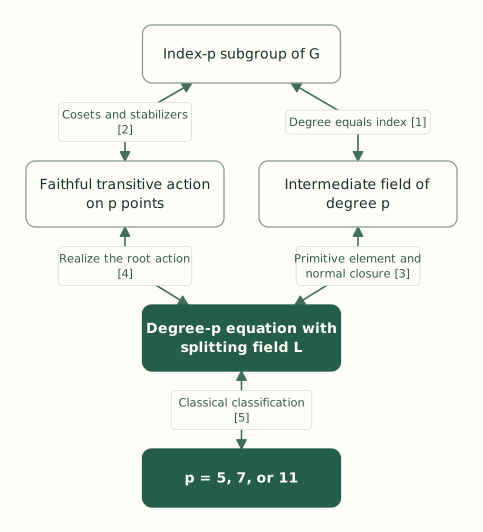
→ deduction or information flow↔ equivalence
Corollary of classical Galois theory
For the given extension, let be the smallest degree of a separable irreducible polynomial over whose splitting field is . Then
Why the degree classification is complete
For a subgroup , put . The action on has kernel
The same intersection fixes the normal closure of inside . Every proper subgroup of the simple group has trivial core. As is finite separable, write . The minimal polynomial of has degree and splitting field . Conversely, a root of any such irreducible polynomial has a stabilizer of index equal to its degree.
The translation on has order . Any faithful action on points embeds into , so . The natural projective-line action is faithful and transitive, giving degree . Thus the minimum is precisely when an index- subgroup exists; otherwise it is .
Scope. The extension is given in advance; this does not assert that the group is realizable over every field. The prime restriction matters: for , index- subgroups exist but are not core-free, and the corresponding lower-degree equations lose part of the splitting field. The corollary above is deduced from the cited results and the displayed argument; it is not claimed as a new theorem of Pálfy.
Inspect all 5 connections and exact references
| Connection | Statement and source |
|---|---|
| 1Index-p subgroup of G ↔ Intermediate field of degree pEquivalence | The Galois correspondence sends H to its fixed field E=L^H and gives [E:K]=[G:H].
|
| 2Index-p subgroup of G ↔ Faithful transitive action on p pointsEquivalence | An index-p subgroup gives a transitive action on its p cosets. Its kernel is the core of H; simplicity makes this kernel trivial. Conversely, a point stabilizer in a transitive degree-p action has index p.
|
| 3Intermediate field of degree p ↔ Degree-p equation with splitting field LEquivalence | A primitive element of E has degree p. The normal closure of E in L is fixed by the core of its stabilizer; simplicity makes that core trivial. Conversely, any root of an irreducible degree-p polynomial generates a degree-p intermediate field.
|
| 4Faithful transitive action on p points ↔ Degree-p equation with splitting field LEquivalence | For the given extension L/K, the fixed field of a point stabilizer has a primitive element whose conjugates give this faithful action. Conversely, an irreducible polynomial with splitting field L gives a faithful transitive action on its roots.
|
| 5Degree-p equation with splitting field L ↔ p = 5, 7, or 11Equivalence | Through the equivalent subgroup condition, Theorem 2 and the constructions in Section 4 give exactly p=5,7,11. The subgroup classification is classical; the cited exposition is a recent preprint.
|
Sources and scope checked .
Background
The classical problem was to solve equations by radicals. Galois theory replaces the search for a formula by a condition on a group: over a field of characteristic zero, a polynomial is solvable by radicals if and only if its Galois group is solvable. Thus an equation with group , for , has no expression for all its roots using only field operations and radicals. Particular equations of high degree can still be solvable; cyclotomic equations are a basic example.
Irreducibility criteria developed alongside this theory. Gauss’s lemma reduces rational factorization to integer factorization. Schönemann’s 1846 criterion and Eisenstein’s 1850 paper use divisibility by a prime. Dumas’s 1906 work organizes valuations through Newton polygons and combines information from several primes. These methods remain useful because they often give short proofs for entire families.
Reduction modulo primes provides a second connection with arithmetic. At a prime where the reduction is squarefree and its degree is unchanged, factor degrees give the cycle lengths of a Frobenius element. Chebotarev’s theorem describes how often conjugacy classes occur. This turns the factorization of a polynomial over finite fields into information about its Galois group over .
References 4
- Milne2022 · Theorems 3.28 and 5.34Solvability by radicals in characteristic zero.Author’s book page
- cox2011eisenstein · pp. 3–4Historical attribution of the irreducibility criterion.Source
- bonciocat2015multiprime · IntroductionDumas and the several-prime method.Source
- StevenhagenLenstra1996Frobenius factorization types, Chebotarev’s theorem, and their history.Source
Arithmetic and geometric connections
Over , an irreducible polynomial of degree defines . This field already contains every root, and its Galois group is cyclic, generated by . Over , the corresponding root field need not be normal, and the group can be much larger. Finite-field factorization nevertheless supplies useful local information about rational polynomials.
Passing from to retains information lost by reduction modulo . Coefficient valuations determine Newton polygons; their slopes restrict degrees of local factors and ramification indices. A rational factor must satisfy these restrictions at every prime. Combining primes can therefore prove irreducibility even when no one prime does.
For a polynomial , one can first study factorization and the Galois group over the function field , then ask what happens after is replaced by an element of . Hilbert irreducibility explains why many rational specializations preserve irreducibility. Over the complex numbers, analytic continuation of roots away from branch values gives a monodromy group; for a separable polynomial over , it agrees with the Galois group in its action on the roots.
In several variables, absolute irreducibility is also a geometric condition. Over an algebraically closed field, an irreducible polynomial generates a prime ideal and defines an irreducible reduced hypersurface. Newton polytopes, specialization, and factorization over function fields provide methods beyond the one-variable criteria.
References 4
- Milne2022 · Proposition 4.23Author’s book page
- Hajir2005 · §2.1Source
- Serre2007TopicsHilbert irreducibility and Galois realizations.Source
- Lang2002Polynomial rings, prime ideals, and field extensions.Source
Individual polynomials and families
For a specified polynomial over , exact algorithms can compute its irreducible factors and Galois group. A proof for a family is a different problem: it must cover all parameters in a stated range. Computations suggest a pattern and settle individual cases, but do not by themselves establish a uniform assertion.
The distinction is already visible in the group action. Irreducibility proves transitivity. To prove , one needs additional information, often primitivity and suitable cycles. Once this containment is known, the discriminant decides whether or . A nonsquare discriminant alone gives only .
The remaining articles develop these steps for special families, compositions, random polynomials, and inverse Galois problems. The central reference for reducibility is Schinzel’s monograph; Prasolov gives a shorter treatment of many techniques, while Cox and Milne develop the field theory and group calculations.
References 5
- GathenGerhard2013Exact factorization algorithms.Source
- FiekerKlueners2014Algorithms for rational polynomial Galois groups.Source
- Schinzel2000Source
- Prasolov2004Source
- Cox2012Source
Questions
Does irreducibility imply a symmetric Galois group?
Scope. Separable polynomials over Q
No. The polynomial is irreducible, but its splitting field is and its group is , acting transitively on four roots. Its transitive group is a proper subgroup of the symmetric group.
References 1
- Milne2022 · Chapter 5Cyclotomic extensions and their automorphism groups.Author’s book page
Related topics
Connected diagrams
- How can several local tests prove irreducibility? · Classical
- Catalan sections: factor reflection, resultants, and full symmetric groups · Claimed
- Central-binomial sections: exact groups and prime reductions · Claimed
- Positive Laguerre parameters: a proposed complete classification · Claimed
Field extensions and minimal polynomials
Minimal polynomials and extension degrees explain the field generated by one root.
Develops intoThe Galois correspondence and intermediate fields
Subgroups describe intermediate fields and changes of the coefficient field.
Applies toReduction modulo primes
Gauss’s lemma allows rational factors to be studied modulo primes.
Develops intoFrobenius and factorization modulo primes
Finite-field factor degrees give cycle types in the global Galois group.
Develops intoTransitivity, primitivity, and cycle criteria
Transitivity, primitivity, and cycles constrain the group.
Contrasts withPolynomials in several variables
Absolute irreducibility becomes a geometric question in several variables.
Linked from 54 articles
- Field extensions and minimal polynomials
- The Galois correspondence and intermediate fields
- Reduction modulo primes
- Schönemann–Eisenstein and Dumas criteria
- Newton polygons and Galois groups
- Root bounds and prime-value criteria
- Irreducibility from integer values
- Sparse polynomials and factor reversal
- Capelli’s theorem and polynomial composition
- Frobenius and factorization modulo primes
- Discriminants, parity, and ramification
- Ramification and inertia
- Transitivity, primitivity, and cycle criteria
- Resolvents and subgroup tests
- Reciprocal polynomials
- Trinomials
- Taylor polynomials
- Generalized Laguerre polynomials
- Hermite, Bessel, and Legendre polynomials
- Krawtchouk polynomials
- Kaneko–Zagier polynomials
- Laguerre polynomials with negative parameters
- Eulerian polynomials
- Bernoulli and Euler polynomials
- Fekete polynomials
- Truncated binomial polynomials
- Stern polynomials
- Five-term Newman polynomials
- Touchard polynomials
- Chromatic polynomials
- Tutte polynomials
- Ehrhart polynomials
- Hecke polynomials and Maeda’s conjecture
- Zero polynomials of Eisenstein series
- Height bounds for exceptional Galois groups
- Random polynomials: models and methods
- Littlewood polynomials
- Factor reversal for random binary polynomials
- Characteristic polynomials of random matrices
- Random reciprocal polynomials of growing degree
- Twisted reciprocity and square discriminants
- Specialization and Hilbert irreducibility
- Critical points and polynomial monodromy
- Inverse Galois theory and generic polynomials
- Composition and iteration
- Polynomial decomposition
- Irreducibility of iterates
- Arboreal Galois groups
- Finite fields and Frobenius
- Polynomials in several variables
- Newton polytopes and irreducibility
- Polynomials with separated variables
- Polynomial fibers and Bertini’s theorem
- Factorization in several variables
References
- Galois Theory
Cox, David A. Edition 2. John Wiley & Sons, 2012.
Read the source - Algebra
Lang, Serge. Edition 3. Springer, Graduate Texts in Mathematics, vol. 211, 2002.
Read the source - Fields and Galois Theory
Milne, James S. Kea Books, 2022.
Author’s book page - Irreducibility tests in Q[T]
Conrad, Keith. Author-hosted expository note.
Read the source - Roots and irreducibles
Conrad, Keith. Author-hosted expository notes.
Read the source - Galois groups as permutation groups
Conrad, Keith. Author-hosted expository notes.
Read the source - The Galois correspondence
Conrad, Keith. Author-hosted expository notes.
Read the source - Permutation Groups
Dixon, John D. and Mortimer, Brian. Graduate Texts in Mathematics 163, Springer, 1996.
Read the source - Galois’s lost proof on PSL(2,p)
Pálfy, Péter P. arXiv:2611.06054v1, 2026.
Read the source - Why Eisenstein Proved the Eisenstein Criterion and Why Schönemann Discovered It First
Cox, David A. The American Mathematical Monthly, 118(1), 3–21, 2011.
Read the source - Schönemann–Eisenstein–Dumas-type irreducibility conditions that use arbitrarily many prime numbers
Bonciocat, Nicolae Ciprian. Communications in Algebra, 43(8), 3102–3122, 2015.
Read the source - Chebotarëv and his density theorem
Stevenhagen, Peter and Lenstra, Jr., Hendrik W. The Mathematical Intelligencer, 18(2), 26–37, 1996.
Read the source - On the Galois group of generalized Laguerre polynomials
Hajir, Farshid. Journal de théorie des nombres de Bordeaux, 17(2), 517–525, 2005.
Read the source - Topics in Galois Theory
Serre, Jean-Pierre. Edition 2. A K Peters/CRC Press, Research Notes in Mathematics 1, 2007.
Read the source - Modern Computer Algebra
von zur Gathen, Joachim and Gerhard, Jürgen. Edition 3. Cambridge University Press, 2013.
Read the source - Computation of Galois groups of rational polynomials
Fieker, Claus and Klüners, Jürgen. LMS Journal of Computation and Mathematics, 17(1), 141–158, 2014.
Read the source - Polynomials with Special Regard to Reducibility
Schinzel, Andrzej. Cambridge University Press, Encyclopedia of Mathematics and its Applications, vol. 77, 2000.
Read the source - Polynomials
Prasolov, Victor V. Springer, Algorithms and Computation in Mathematics, vol. 11, 2004.
Read the source
Comments
Any comments are welcome. Comments appear after the site owner approves them. Privacy policy.