Overview
- How does the substitution reduce the degree?
- When does irreducibility of the polynomial in imply irreducibility in ?
- When is the Galois group ?
Trace polynomial
Let have characteristic different from . A monic polynomial of degree is reciprocal if . Its constant term is then . There is a unique monic of degree such that
To construct it, express the symmetric Laurent polynomial in the basis . The recurrence , with , expresses every as a polynomial in . The roots of record the inverse pairs of roots of .
References 1
- AndersonBertelliODorney2026 · §2Reciprocal polynomials and the trace substitution.Source
Irreducibility criterion
Criterion
Assume is irreducible and separable, and let be one of its roots. Then is irreducible over if and only if is not a square in .
A root above satisfies , and . Thus . The second factor is two exactly when the quadratic discriminant is a nonsquare. This proves the criterion by comparing the degree with . Conversely, irreducibility of forces irreducibility of .
References 1
- MinacNguyenTan2023 · §4The quadratic-lift method for reciprocal polynomials; the degree argument is included here.Source
Galois group
Suppose is separable. Let be the splitting field of , with roots . The splitting field of is
Every Galois automorphism permutes the inverse pairs and may exchange the two roots in each pair. Hence . Its quotient on pairs is ; its kernel has order , where is the dimension of the span of the square classes in . In particular, the full wreath product occurs exactly when the quotient is and all classes are independent.
References 2
- AndersonBertelliODorney2026 · §2Signed permutations are the natural ambient group.Source
- Cox2012Quadratic extensions and Galois actions; the square-class formulation is standard Kummer theory.Source
Connections and evidence
ClassicalWhen does a reciprocal polynomial have the full signed group?
Passing to inverse pairs halves the degree. Recovering the full group then requires both the permutation group on pairs and independent quadratic extensions.
Scope. Let have characteristic different from , and let be monic and separable of degree , with . Put .
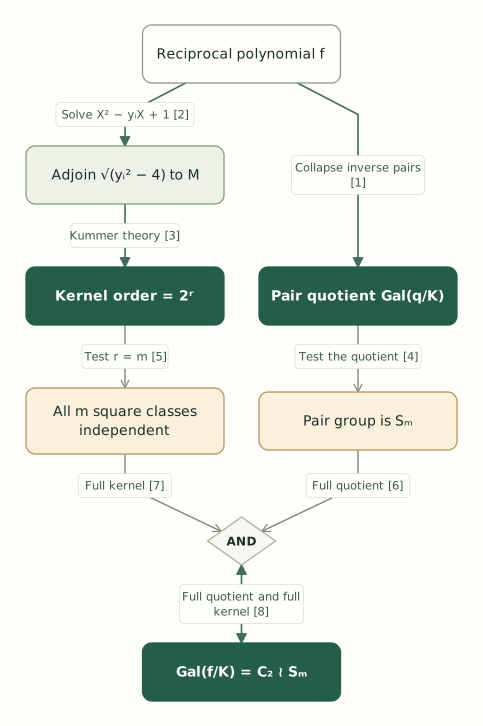
→ deduction or information flow↔ equivalenceAND joint hypotheses
Let be the roots of , let be its splitting field, and put . The assumptions imply and make separable. Its splitting field is
The square classes are taken in , not in the base field. Restriction gives an exact sequence
Consequently, if and only if and all radicand classes are independent. This follows by comparing orders inside the natural signed-permutation group; no splitting of the displayed exact sequence is assumed in advance.
For example, has group , but its lift is . Both radicands are , so the kernel has rank one and , of order four rather than eight.
The identity detects parity, not the full kernel. A square discriminant forces even total pair flips. For even polynomials , assuming also , the same method uses opposite pairs and radicands ; this connects directly to parity-reduced Legendre and Hermite polynomials.
Inspect all 8 connections and exact references
| Connection | Statement and source |
|---|---|
| 1Reciprocal polynomial f → Pair quotient Gal(q/K)Deduction | The map α↦α+α⁻¹ identifies inverse pairs with roots of q, and restriction surjects onto the Galois group of q.
|
| 2Reciprocal polynomial f → Adjoin √(yᵢ² − 4) to MDeduction | Writing M for the splitting field of q, the quadratic formula gives the splitting field L=M(√(y₁²−4),…,√(yₘ²−4)).
|
| 3Adjoin √(yᵢ² − 4) to M → Kernel order = 2ʳDeduction | If r is the dimension of the span of the radicand square classes in M×/Mײ, then [L:M]=2ʳ.
|
| 4Pair quotient Gal(q/K) → Pair group is SₘConstruction / input | The condition to verify is that the quotient on the m inverse pairs is the full symmetric group; it is not automatic. |
| 5Kernel order = 2ʳ → All m square classes independentConstruction / input | The condition to verify is maximal square-class rank m; it is not automatic from irreducibility. |
| 6Pair group is Sₘ → ANDConstruction / input | The full quotient is the first necessary and sufficient condition in the joint criterion. |
| 7All m square classes independent → ANDConstruction / input | Independent square classes give the full order-2ᵐ kernel, the second condition in the joint criterion. |
| 8AND ↔ Gal(f/K) = C₂ ≀ SₘEquivalence | The Galois group embeds in C₂≀Sₘ; it equals that group exactly when its quotient has order m! and its kernel has order 2ᵐ.
|
Sources and scope checked .
Examples
Example
For , the lift is . The polynomial is irreducible, but in , so the quadratic over the root field splits.
Example
For , the lift is . Its splitting field is , of degree four, and its group is . Both radicands equal , so their square classes span only one dimension. The group is a proper subgroup of the order-eight wreath product.
Discriminant
For monic , the quadratic-factor decomposition gives
Indeed, the factors have discriminants , and the resultant of the factors indexed by is . Multiplying the discriminants and the squares of these resultants proves the identity. When is separable, its discriminant is a square in exactly when the group on its roots lies in . This does not determine the entire kernel.
The same construction applies to even polynomials , with pairs and radicands . Affine reflection becomes this situation after centering at .
A nonsquare norm proves that a radicand is nonsquare. The converse fails: a square norm need not come from a square.
References 2
- AndersonBertelliODorney2026 · §2Discriminants in the reciprocal setting.Source
- CullinanHajir2014 · §1The analogous signed action for even Legendre polynomials.Source
Normalizations for paired roots
The following conventions are over . The table lists specified algebraic factors; it does not claim that every remaining polynomial is irreducible. If the remainder is separable and has no root fixed by the indicated involution, its roots give an embedding into .
| Family | Normalization | Degree of the remainder | Pair variable |
|---|---|---|---|
| Eulerian | , ; remove exactly when is even. | ||
| Prime quadratic Fekete | Use , , as defined in the Fekete normalization. | or | |
| Physicists’ Hermite | , , . | ||
| Legendre | , , . | ||
| Binary Krawtchouk | , , , . | ; exclude repeated or zero roots before using the pair action. | |
| Bernoulli | , even ; , odd . | or | |
| Appell Euler | , odd ; , even . | or |
For inverse pairs the radicands are ; for opposite pairs they are . The pair group, irreducibility of the lift, and the rank of the quadratic kernel require separate arguments. Repeated factors must be removed when describing the action on distinct roots.
References 6
- AndersonBertelliODorney2026 · §2Reciprocal root pairs and their permutation groups.Source
- CullinanHajir2014 · §1 and §4Parity-normalized Legendre polynomials.Source
- Cullinan2024 · Equations (1.2.4)–(1.2.5), arXiv v1Centered binary Krawtchouk normalization.Source
- FoataSchutzenberger1970 · Eulerian generating functions and reciprocityAuthorized digital retypesetting
- CullinanHajirSell2009 · §1Physicists’ Hermite–Laguerre identities.Source
- DLMFBernoulliEuler · §§24.2 and 24.4Reflection identities and the specified rational factors.Source
Questions
When are the quadratic extensions independent?
Scope. A specified reciprocal family over a field of characteristic different from 2.
After determining the Galois group of the trace polynomial, the remaining problem is to find relations among the radicands in its splitting field. These square-class relations determine the kernel of the action on inverse pairs.
References 1
Related topics
Eulerian polynomials
Eulerian reciprocity produces inverse pairs after the forced factor is removed.
Applies toFekete polynomials
Character identities produce reciprocal normalizations and special-value tests.
UsesDiscriminants, parity, and ramification
The discriminant detects one parity character of the full action.
GeneralizesHermite, Bessel, and Legendre polynomials
Even polynomials have an analogous action on sign pairs.
Linked from 14 articles
- Root bounds and prime-value criteria
- Sparse polynomials and factor reversal
- Transitivity, primitivity, and cycle criteria
- Resolvents and subgroup tests
- Hermite, Bessel, and Legendre polynomials
- Krawtchouk polynomials
- Eulerian polynomials
- Bernoulli and Euler polynomials
- Fekete polynomials
- Stern polynomials
- Height bounds for exceptional Galois groups
- Factor reversal for random binary polynomials
- Random reciprocal polynomials of growing degree
- Twisted reciprocity and square discriminants
References
- Galois groups of reciprocal polynomials and the van der Waerden-Bhargava theorem
Anderson, Theresa C. and Bertelli, Adam and O'Dorney, Evan M. Algebra & Number Theory, 20(3), 603–628, 2026.
Read the source - Fekete polynomials, quadratic residues, and arithmetic
Mináč, Ján and Nguyen, Tung T. and Tân, Nguyen Duy. Journal of Number Theory, 242, 532–575, 2023.
Read the source - Galois Theory
Cox, David A. Edition 2. John Wiley & Sons, 2012.
Read the source - On the Galois groups of Legendre polynomials
Cullinan, John and Hajir, Farshid. Indagationes Mathematicae, 25(3), 534–552, 2014.
Read the source - On the irreducibility of the Krawtchouck polynomials
Cullinan, John. Journal of the Ramanujan Mathematical Society, 39(4), 323–335, 2024.
Read the source - Théorie géométrique des polynômes eulériens
Foata, Dominique and Schützenberger, Marcel-Paul. Springer, Lecture Notes in Mathematics, vol. 138, 1970.
Authorized digital retypesetting - Algebraic properties of a family of Jacobi polynomials
Cullinan, John and Hajir, Farshid and Sell, Elizabeth. Journal de théorie des nombres de Bordeaux, 21(1), 97–108, 2009.
Read the source - Bernoulli and Euler Polynomials (Chapter 24)
NIST Digital Library of Mathematical Functions. NIST Digital Library of Mathematical Functions.
Read the source - Fields and Galois Theory
Milne, James S. Kea Books, 2022.
Author’s book page
Comments
Any comments are welcome. Comments appear after the site owner approves them. Privacy policy.