Overview
- Which factors at , , and occur in the prime-conductor family?
- Why is irreducibility equivalent to that of its trace polynomial?
- What would prove the conjectured group ?
Definition
For an odd prime , let be the Legendre symbol and define
The coefficients encode the quadratic residues modulo . These polynomials entered the study of Dirichlet L-functions; their special values also connect to class numbers and generalized Bernoulli numbers. Their coefficients are deterministic and strongly correlated, so theorems about independent random signs cannot be applied directly.
References 1
- MinacNguyenTan2023 · IntroductionHistorical motivation and arithmetic special values.Source
Normalization
The identity gives . Define
The factors at and have precisely the indicated multiplicities. The result is monic and reciprocal. Write , with or , respectively. For , one has . For , irreducibility of over is equivalent to irreducibility of . This equivalence uses arithmetic special values, not reciprocity alone.
References 1
- MinacNguyenTan2023 · Proposition 2.1, Definition 3.2, and Corollary 4.2Exact forced factors and irreducibility equivalence.Source
Example
Example
The quadratic residues modulo are , so
Dividing by gives
Thus , with roots . Their field is , and the quadratic radicands are . Each has norm . A square in has rational norm equal to a rational square, so neither radicand is a square. Their product is , which is not a square in the real field . The two square classes are independent, giving and . The group of is therefore .
Galois-group conjecture
Mináč–Nguyen–Tân conjecture that the normalized prime-conductor family has full group , with . This is a conjecture in the cited source, supported by structural results and finite computations. The broader generalized-character family can have additional symmetries and a smaller allowed group.
References 2
- MinacNguyenTan2023 · Conjecture 4.13 in arXiv:2111.05256v3The full wreath-product prediction.Source
- MinacNguyenTan2024Generalized conductors, cyclotomic factors, and extra symmetry.Source
Trace polynomials and square classes
For a generalized character, first determine the cyclotomic factors and reciprocal symmetry. The remaining polynomial can then be written in terms of . This separates the Galois problem into the action on inverse pairs and the quadratic extensions within those pairs. Special values provide square classes; factorizations modulo good primes provide cycle types.
Additional factors, a smaller group on pairs, or a relation among the quadratic radicands can each force a smaller full group.
References 1
- MinacNguyenTan2024The organization by forced factors, trace polynomials, and modular Galois tests.Source
Principal characters
For the principal character modulo , the corresponding polynomial is . Möbius inversion gives
Each quotient is a finite geometric sum, so the expression is polynomial. Chidambaram–Mináč–Nguyen–Tân study its cyclotomic factors, remaining factors, and Galois groups. This family has coefficients 0 and 1 and is not covered by the prime quadratic-character conjecture above.
References 1
- ChidambaramMinacNguyenTan2025 · IntroductionPrincipal-character family, cyclotomic factors, and associated conjectures.Source
Principal characters at semiprime moduli
For odd primes , put and
The indicated division is proved. Whether it removes every cyclotomic factor is part of the conjecture.
References 1
- ChidambaramMinacNguyenTan2025 · Proposition 3.1, Theorem 3.2, and Definitions 3.3, 3.6 (published version)Proposition 3.1 proves the indicated divisibility; Theorem 3.2 makes completeness conditional on Conjecture 2.11.Source
Generalized quadratic characters
For a nontrivial fundamental discriminant , write and
The symbol is the Kronecker symbol. Let be the multiplicity of in . The monic non-cyclotomic remainder is
It may be constant for small conductors; irreducibility is asked only when its degree is positive.
The character identity pairs the nonzero roots by inversion. After all cyclotomic factors are removed, no fixed root remains. Thus a nonconstant is reciprocal of even degree.
References 1
- MinacNguyenTan2024 · Definitions 3.1–3.2, Question 3.9, and Conjecture 10.6 in arXiv:2206.11778v2The nonconstant restriction excludes the elementary cases with only cyclotomic factors.Source
Comparison of the three families
All three families are defined over , but their quotients remove different factors.
| Family and parameter | Polynomial and removed factors | Degree and pair polynomial | Scope of the removal |
|---|---|---|---|
| Quadratic character, prime | ; divide by if , and by if . | ; or , respectively. | The multiplicities of the displayed factors are exact. Irreducibility of this quotient is the conjecture; it is not defined by removing all cyclotomic factors. |
| Principal character, , odd primes | ; divide by , with defined above. | ; . | Divisibility is proved. Completeness of the listed cyclotomic factors remains conditional on the source conjecture. |
| Quadratic character, nontrivial fundamental discriminant | ; divide by and every actual cyclotomic factor, with full multiplicity. | ; when nonconstant, . | The removal is complete by definition. Determining its factors and multiplicities is a separate problem. |
For a separable quotient of degree , reciprocity gives an ambient group ; extra symmetries can force a smaller group. Three questions remain distinct: is the pair polynomial irreducible, is its reciprocal lift irreducible, and are the quadratic square classes independent over the pair splitting field? For the prime quadratic family, Corollary 4.2 proves the first two equivalent using special values. It does not settle the third. See the lift criterion and the quadratic kernel.
References 3
- MinacNguyenTan2023 · Definition 3.2; Corollary 4.2; Conjectures 4.9 and 4.13Source
- ChidambaramMinacNguyenTan2025 · Proposition 3.1, Theorem 3.2, Definitions 3.3 and 3.6; published versionCompleteness of the semiprime cyclotomic divisor is conditional.Source
- MinacNguyenTan2024 · Definitions 3.1–3.2 and Conjectures 10.6, 11.14; arXiv:2206.11778v2Source
Necklace functions
Necklace polynomials are
The value counts monic irreducible polynomials of degree over ; this does not say that itself is irreducible. Hyde studies its cyclotomic factors.
For , a 2026 preprint studies . For squarefree , the principal-character Fekete polynomial satisfies
For , let be a primitive -th root of unity. If has no pole at any with , and for every residue class , then : group the terms by residue class. Since these are rational functions, divisibility means divisibility of the numerator after cancellation. The results do not prove irreducibility of the remaining Fekete factor.
References 2
- Hyde2022Necklace · §1 and Theorem 1.1Source
- MinhEtAl2026RationalNecklace · §1; Definition 2.5; Theorems 2.7 and 4.5, arXiv v1Source
Connections and evidence
PublishedWhich new primes create a prescribed Fekete factor?
For a fixed squarefree modulus and cyclotomic order, adjoining one prime is governed exactly by the stabilizer of one cyclotomic-field value.
Scope. Let be squarefree, with , and let be a prime not dividing . This concerns the principal-character Fekete polynomial.
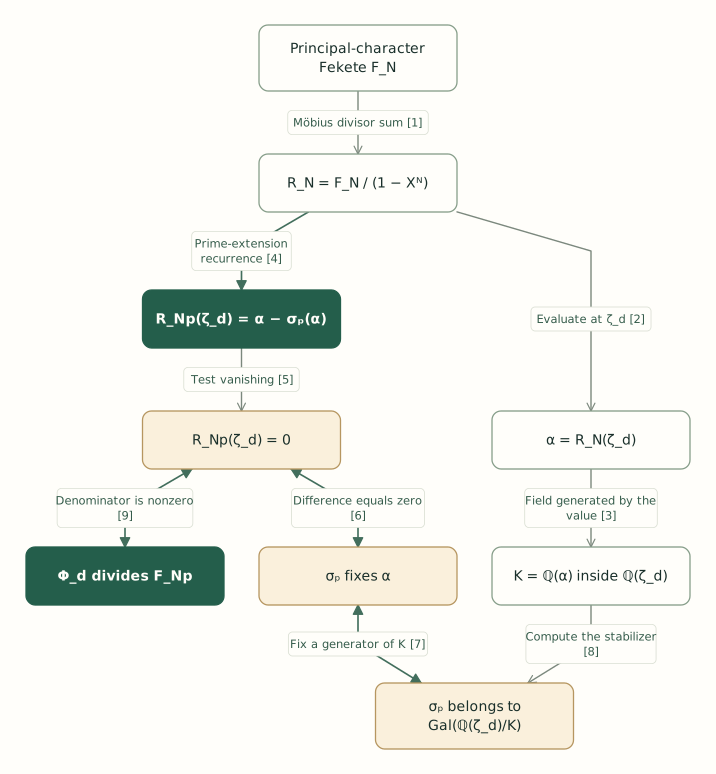
→ deduction or information flow↔ equivalence
This is an elementary corollary of the published recurrence, proved below. Define
For a primitive -th root , put , , and . Let send to . Then the complete one-prime-extension criterion is
Proof. The published recurrence gives . Rational coefficients imply . Since and , both denominators and are nonzero. Evaluating the recurrence proves the first equivalence; fixing a field generator proves the second.
For , exact arithmetic gives . Thus has degree two, whereas , and for every prime ,
The 2026 preprint presents this small-field mechanism in a broader framework. Here the recurrence, field argument, and example are checked directly. The criterion decides this extension problem exactly; it does not classify every cyclotomic factor for arbitrary moduli or prove irreducibility of the noncyclotomic remainder.
Inspect all 9 connections and exact references
| Connection | Statement and source |
|---|---|
| 1Principal-character Fekete F_N → R_N = F_N / (1 − Xᴺ)Construction / input | Divide by 1−Xᴺ and use Proposition 2.17 to express Rₙ as a sum over divisors of N.
|
| 2R_N = F_N / (1 − Xᴺ) → α = R_N(ζ_d)Construction / input | The assumption d∤N makes evaluation regular; the recent preprint gives explicit small-field evaluations and a broader sufficient framework.
|
| 3α = R_N(ζ_d) → K = ℚ(α) inside ℚ(ζ_d)Construction / input | The value α defines the intermediate field K=ℚ(α).
|
| 4R_N = F_N / (1 − Xᴺ) → R_Np(ζ_d) = α − σₚ(α)Deduction | The published recurrence Rₙₚ(X)=Rₙ(X)−Rₙ(Xᵖ), together with σₚ(ζ_d)=ζ_dᵖ, gives the displayed equality.
|
| 5R_Np(ζ_d) = α − σₚ(α) → R_Np(ζ_d) = 0Construction / input | The equality reduces the desired vanishing test to comparing α with its conjugate. |
| 6R_Np(ζ_d) = 0 ↔ σₚ fixes αEquivalence | The value Rₙₚ(ζ_d) vanishes exactly when σₚ(α)=α.
|
| 7σₚ fixes α ↔ σₚ belongs to Gal(ℚ(ζ_d)/K)Equivalence | An automorphism fixing ℚ fixes α exactly when it fixes every element of ℚ(α).
|
| 8K = ℚ(α) inside ℚ(ζ_d) → σₚ belongs to Gal(ℚ(ζ_d)/K)Construction / input | The intermediate field determines the subgroup against which the residue class of p is tested. |
| 9R_Np(ζ_d) = 0 ↔ Φ_d divides F_NpEquivalence | Since d∤Np, the denominator 1−ζ_dᴺᵖ is nonzero; vanishing is equivalent to Φ_d dividing Fₙₚ over ℚ.
|
Sources and scope checked .
Questions
Is every normalized prime-conductor Fekete polynomial irreducible?
Scope. Primes ; the quadratic-character quotient specified in the linked normalization; base field .
For a prime , set , where is the Legendre symbol, and let be the specified monic reciprocal quotient of this quadratic-character polynomial. Write , where for and for .
Is always irreducible over ? For this family, Corollary 4.2 proves that this is equivalent to irreducibility of . Mináč–Nguyen–Tân verify both for . This is weaker than their full wreath-product conjecture. Varjú–Xu still describe the all-prime irreducibility assertion as conjectural in 2026.
References 2
- MinacNguyenTan2023 · Corollary 4.2 and Remark 4.15 in arXiv:2111.05256v3Irreducibility is discussed in Remark 4.15 as a consequence of Conjecture 4.13; it has no separate numbered conjecture here.Source
- VarjuXu2026 · Introduction, paragraph before Problem 1.2Current independent source describing the classical Fekete irreducibility conjecture.Source
Does every normalized prime-conductor Fekete polynomial have the full wreath-product group?
Scope. Primes ; the quadratic-character quotient specified in the linked normalization; ; base field .
For a prime , set , where is the Legendre symbol, and let be the specified monic reciprocal quotient of this quadratic-character polynomial. Write , where for and for .
The cited conjecture predicts , acting on the roots arranged in inverse pairs. This predicts both irreducibility and a maximal quadratic kernel. It remains a conjecture in the cited version; finite computations do not prove the statement for all primes.
References 1
- MinacNguyenTan2023 · Conjecture 4.13 in arXiv:2111.05256v3Source
Which cyclotomic factors occur for principal characters?
Scope. Squarefree n>1; d>1 with d not dividing n.
Set . The conjecture says that exactly when the numbers
are equal for all residue classes with . Equal counts imply divisibility; the converse is conjectural.
References 1
- ChidambaramMinacNguyenTan2025 · Proposition 2.9 and Conjecture 2.11Source
Is the semiprime remainder irreducible?
Scope. Principal characters; with odd primes ; the specified quotient ; base field .
Let for odd primes , and put . Use the quotient
with the explicit set in the semiprime normalization. The indicated divisibility is proved; whether these are all cyclotomic factors is conjectural.
Conjecture 6.9 asserts that this is irreducible over . The source verifies all such .
References 1
- ChidambaramMinacNguyenTan2025 · Conjecture 6.9 and the preceding computational statement, p. 86Source
What is the semiprime Galois group?
Scope. Principal characters; with odd primes ; the specified quotient ; ; base field .
Let for odd primes , and put . Use the quotient
with the explicit set in the semiprime normalization. The indicated divisibility is proved; whether these are all cyclotomic factors is conjectural.
Define by , with . The proposed groups are and
where adds the coordinates. Both predictions hold for all such .
References 1
- ChidambaramMinacNguyenTan2025 · Proposition 3.7, Questions 7.2 and 7.6, and Propositions 7.3 and 7.7Source
What are the cyclotomic multiplicities for quadratic characters?
Scope. Nontrivial fundamental discriminants Δ; all d≥1.
Determine . This includes factors whose orders do not divide ; multiplicities can exceed one.
References 1
- MinacNguyenTan2024 · Question 3.9 and §§4–10 in arXiv:2206.11778v2Source
Is the quadratic-character remainder irreducible?
Scope. Nontrivial fundamental discriminants ; ; base field .
For , put
where the symbol is the Kronecker symbol. Let be the monic polynomial obtained from by removing every actual cyclotomic factor with its full multiplicity; see the exact remainder definition. When , is irreducible over ? Conjecture 10.6 predicts one irreducible non-cyclotomic factor. This extends the prime-conductor question to composite conductors.
References 1
- MinacNguyenTan2024 · Conjecture 10.6 in arXiv:2206.11778v2Stated here only for nonconstant remainders.Source
Does the square discriminant give the only group restriction?
Scope. Δ=−3p with p≡5 mod8 prime.
Define
The source proves , where is summation. Is this containment always an equality?
References 1
- MinacNguyenTan2024 · Definition 10.3, Proposition 10.4, Proposition 11.12, Corollary 11.13, and §11.5 in arXiv:2206.11778v2A precise subcase of the generalized Galois-group problem; the proven containment is distinguished from the conjectural equality.Source
Related topics
Connected diagrams
Browse all diagrams →Reciprocal polynomials
The trace substitution and quadratic kernel organize the root action.
Contrasts withEulerian polynomials
Both families are reciprocal after normalization, but their arithmetic inputs differ.
UsesFrobenius and factorization modulo primes
Good-prime factorizations constrain the group on the remaining roots.
Supplies examples forBernoulli and Euler polynomials
Generalized Bernoulli special values connect character sums with arithmetic invariants.
Related familyStern polynomials
Cyclotomic factors must be separated before testing the remaining polynomial.
Linked from 1 articles
References
- Fekete polynomials, quadratic residues, and arithmetic
Mináč, Ján and Nguyen, Tung T. and Tân, Nguyen Duy. Journal of Number Theory, 242, 532–575, 2023.
Read the source - Galois Theory
Cox, David A. Edition 2. John Wiley & Sons, 2012.
Read the source - On the arithmetic of generalized Fekete polynomials
Mináč, Ján and Nguyen, Tung T. and Tân, Nguyen Duy. Experimental Mathematics, 33(4), 723–754, 2024.
Read the source - Fekete polynomials of principal Dirichlet characters
Chidambaram, Shiva and Mináč, Ján and Nguyen, Tung T. and Tân, Nguyen Duy. Journal of Experimental Mathematics, 1(1), 51–93, 2025.
Read the source - Cyclotomic factors of necklace polynomials
Hyde, Trevor. Acta Arithmetica, 204(4), 287–316, 2022.
Read the source - Cyclotomic factors of rational necklace functions
Nguyen Cao Minh and Nguyen Vu Hoang Minh and Dung Nguyen and Tung T. Nguyen and Nguyen Duy Tan and Duong Tran. arXiv:2606.02324v1, 2026.
Read the source - A random polynomial with multiplicative coefficients is almost surely irreducible
Varjú, Péter P. and Xu, Max Wenqiang. International Mathematics Research Notices, 2026(16), rnag178, 2026.
Read the source - The Galois correspondence
Conrad, Keith. Author-hosted expository notes.
Read the source
Comments
Any comments are welcome. Comments appear after the site owner approves them. Privacy policy.