Overview
- Which cycle type follows from factorization modulo a prime?
- When does a polynomial have an irreducible reduction?
- How do modular factorizations prove that a quintic has group S₅?
The Dedekind–Frobenius theorem
Theorem · Dedekind–Frobenius
Let be nonconstant, monic, and separable, and let be the Galois group of its splitting field over , acting on its roots. If and
is its factorization into distinct monic irreducibles, then contains a permutation whose cycle lengths are .
The cycle statement does not require irreducibility of . Irreducibility is the additional condition that makes transitive. For nonmonic integral polynomials, also exclude primes dividing the leading coefficient.
References 2
- ConradModP · Theorem 1 and its proofThe note treats irreducible monic polynomials; the same reduction argument gives the separable form stated here.Source
- Milne2022 · Chapter 4, “Computing Galois groups over Q”Author’s book page
Frobenius orbits
Choose a prime of the splitting field above . The discriminant condition ensures that the roots remain distinct after reduction. Frobenius acts on the residue field by . A root of an irreducible degree- factor has an orbit of length exactly under this map. Lifting that action to the roots gives the required permutation.
A different choice of conjugates Frobenius. Thus factorization determines the cycle type. It does not identify the root labels, so permutations obtained from different primes have no specified common labeling.
References 1
- ConradModP · Proof of Theorem 1Source
Example
Example:
Take . Modulo , it has no root. The only monic irreducible quadratics over are
The remainders on division of by these are , respectively. Every reducible quintic has a factor of degree at most two, so is irreducible over . Hence is irreducible over , and its group contains a 5-cycle.
Modulo ,
with distinct irreducible factors. This gives an element of type , whose cube is a transposition.
A transitive action of prime degree is primitive. A primitive group containing a transposition is the full symmetric group, as proved in the permutation-group entry. Therefore .
Modular factorizations
Modulo 2
- Factor degrees
- 2 + 3
- Squarefree reduction
- Yes
- Possible proper factor degrees
- 2, 3
The factor degrees are the cycle lengths of a Frobenius element. Every proper rational factor has one of the listed degrees.
Modulo 3
- Factor degrees
- 5
- Squarefree reduction
- Yes
- Possible proper factor degrees
- None
The irreducible reduction proves irreducibility over Q and gives a cycle of full length in the Galois group.
Modulo 5
- Factor degrees
- 5
- Squarefree reduction
- Yes
- Possible proper factor degrees
- None
The irreducible reduction proves irreducibility over Q and gives a cycle of full length in the Galois group.
Modulo 7
- Factor degrees
- 2 + 3
- Squarefree reduction
- Yes
- Possible proper factor degrees
- 2, 3
The factor degrees are the cycle lengths of a Frobenius element. Every proper rational factor has one of the listed degrees.
Modulo 11
- Factor degrees
- 5
- Squarefree reduction
- Yes
- Possible proper factor degrees
- None
The irreducible reduction proves irreducibility over Q and gives a cycle of full length in the Galois group.
References 2
- ConradSnAn · Theorem 2.1Recognition criterion used after the explicit finite-field computations.Source
- Selmer1956Classical irreducibility of the broader trinomial family; the present degree-five proof is self-contained.Source
Connections and evidence
ClassicalHow do two modular factorizations determine S₅?
One prime proves transitivity; another supplies a transposition. Prime degree supplies primitivity, and the two branches together determine the full group.
Scope. Let and , acting on its five roots.
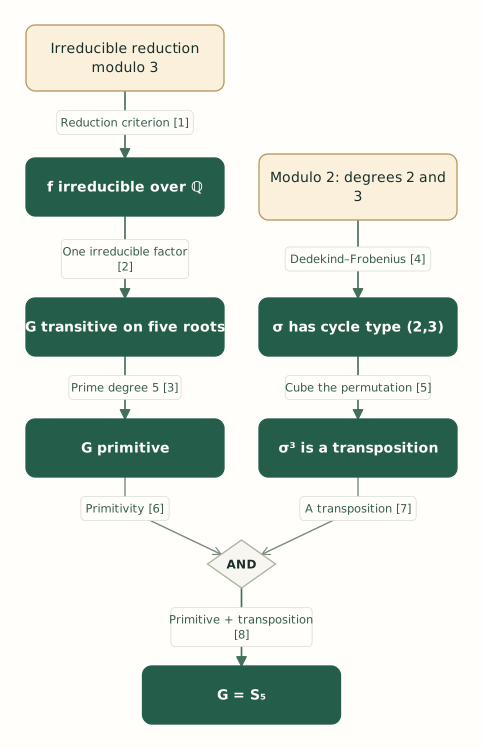
→ deduction or information flowAND joint hypotheses
The complete arithmetic certificate is
The two factors modulo are irreducible: each has degree two or three and neither has a root in . Their distinctness makes the reduction squarefree. For an exact check modulo , polynomial arithmetic gives and . The finite-field irreducibility criterion for prime degree five then applies. The discriminant calculation independently confirms that both primes are good.
The left branch excludes nontrivial block systems. The right produces a permutation exchanging exactly two roots: if , then . Both properties are needed for the final group criterion. Transitivity and a transposition alone do not suffice in composite degree; the order-eight dihedral action on four points is a counterexample.
The same group certificate has a geometric consequence: Zarhin’s theorem applies to , whose genus-two Jacobian has geometric endomorphism ring .
Inspect all 8 connections and exact references
| Connection | Statement and source |
|---|---|
| 1Irreducible reduction modulo 3 → f irreducible over ℚDeduction | The monic degree-five polynomial retains its degree modulo 3, so irreducible reduction proves irreducibility over the rationals.
|
| 2f irreducible over ℚ → G transitive on five rootsDeduction | Irreducibility is equivalent to transitivity of the Galois action on the five roots.
|
| 3G transitive on five roots → G primitiveDeduction | In a transitive action block sizes divide the degree; prime degree has no nontrivial block sizes.
|
| 4Modulo 2: degrees 2 and 3 → σ has cycle type (2,3)Deduction | The reduction modulo 2 is squarefree, and its irreducible factors have degrees 2 and 3; the Galois group therefore contains that cycle type.
|
| 5σ has cycle type (2,3) → σ³ is a transpositionDeduction | The two cycles are disjoint; cubing kills the 3-cycle and leaves the 2-cycle.
|
| 6G primitive → ANDConstruction / input | Primitivity is one of the two hypotheses required by the transposition criterion. |
| 7σ³ is a transposition → ANDConstruction / input | The existence of a transposition is the second hypothesis required by the criterion. |
| 8AND → G = S₅Deduction | A primitive permutation group containing a transposition is the full symmetric group.
|
Sources and scope checked .
Chebotarev density
By Chebotarev, every conjugacy class of occurs at infinitely many unramified primes. The density for a class is ; a cycle type may comprise several classes of , in which case their densities add.
Consequently, an irreducible polynomial of degree has an irreducible reduction at some good prime if and only if contains an -cycle. Transitivity alone does not guarantee this. For , the group is the Klein four-group and no good prime yields an irreducible quartic reduction.
References 2
- StevenhagenLenstra1996Chebotarev density and Frobenius interpretation.Source
- ConradAllPrimesSource
Limits of modular tests
Each squarefree reduction proves that its cycle type occurs in the Galois group. Failure to observe a cycle type in a finite search does not prove its absence. To exclude a type, one needs a group-theoretic restriction or another exact argument.
For example, if the Galois group contains no -cycle, every good reduction of a degree- polynomial is reducible. If modular cycle types leave several possible groups, ramification, the discriminant or a resolvent may distinguish them.
References 1
- ConradSnAn · Section 1Source
Questions
Does every irreducible rational polynomial remain irreducible modulo some prime?
Scope. Separable irreducible polynomials over Q; good primes preserve degree and give squarefree reduction.
No. For a polynomial of degree , an irreducible reduction at a good prime exists exactly when its Galois group contains an -cycle. The polynomial is a counterexample: it is irreducible over , and its Klein four-group contains no 4-cycle.
References 2
Related topics
Connected diagrams
- How can several local tests prove irreducibility? · Classical
- Catalan sections: factor reflection, resultants, and full symmetric groups · Claimed
- Central-binomial sections: exact groups and prime reductions · Claimed
- Tridiagonal matrices, Galois groups, and spectral uncertainty · Conditional
Transitivity, primitivity, and cycle criteria
Permutation-group criteria determine which groups contain the observed cycle types.
UsesDiscriminants, parity, and ramification
The discriminant identifies good primes and the parity character.
Contrasts withNewton polygons and Galois groups
Ramification and Newton polygons apply at primes where reduction is not squarefree.
Applies toAlgorithms for Galois groups
Modular factorizations restrict the candidate groups in an exact computation.
Linked from 23 articles
- Foundations: polynomials, fields, and Galois groups
- Reduction modulo primes
- Discriminants, parity, and ramification
- Ramification and inertia
- Transitivity, primitivity, and cycle criteria
- Trinomials
- Taylor polynomials and Katz–Rivin questions
- Eulerian polynomials
- Bernoulli and Euler polynomials
- Fekete polynomials
- Hecke polynomials and Maeda’s conjecture
- Zero polynomials of Eisenstein series
- Height bounds for exceptional Galois groups
- Random polynomials: models and methods
- Littlewood polynomials
- Factor reversal for random binary polynomials
- Characteristic polynomials of random matrices
- Random reciprocal polynomials of growing degree
- Twisted reciprocity and square discriminants
- Specialization and Hilbert irreducibility
- Arboreal Galois groups
- Finite fields and Frobenius
- Algorithms for Galois groups
References
- Galois groups over Q and factorizations mod p
Conrad, Keith. Author-hosted expository note.
Read the source - Fields and Galois Theory
Milne, James S. Kea Books, 2022.
Author’s book page - Recognizing Galois groups S_n and A_n
Conrad, Keith. Author-hosted expository note.
Read the source - On the irreducibility of certain trinomials
Selmer, Ernst S. Mathematica Scandinavica, 4, 287–302, 1956.
Read the source - Chebotarëv and his density theorem
Stevenhagen, Peter and Lenstra, Jr., Hendrik W. The Mathematical Intelligencer, 18(2), 26–37, 1996.
Read the source - An irreducible that factors modulo all primes
Conrad, Keith. Author-hosted expository note.
Read the source - Irreducibility tests in Q[T]
Conrad, Keith. Author-hosted expository note.
Read the source - Galois groups as permutation groups
Conrad, Keith. Author-hosted expository notes.
Read the source - The Galois groups of the polynomials x^n+ax^s+b, II
Osada, Hiroyuki. Tohoku Mathematical Journal, 39(3), 437–445, 1987.
Read the source
Comments
Any comments are welcome. Comments appear after the site owner approves them. Privacy policy.