Overview
- When does irreducibility modulo a prime imply irreducibility over Q?
- How can factorizations modulo several primes prove irreducibility?
- Can an irreducible rational polynomial be reducible modulo every prime?
The reduction criterion
Theorem · reduction criterion
Let be primitive of degree . If a prime does not divide its leading coefficient and is irreducible, then is irreducible over .
The leading-coefficient condition is essential. For example, becomes the irreducible linear polynomial modulo . Here reduction lowers the degree, so the criterion does not apply.
Proof
Gauss's lemma turns a rational factorization into in . Since the product of the leading coefficients is not divisible by , both factors retain their positive degrees after reduction. Their reductions would factor , a contradiction.
References 1
- ConradIrredQ · §3 and Appendix AReduction modulo a prime and the Gauss-lemma proof.Source
Factor-degree restrictions
Let be primitive of degree , and let not divide its leading coefficient. Factor its reduction into monic irreducible polynomials, recording each factor with its multiplicity. If their degrees are , define
Every proper rational factor of has degree in . Indeed, Gauss’s lemma gives integral factors, their degrees are preserved modulo , and each reduced factor is a product of some of the listed irreducible factors.
If primes satisfy
then is irreducible over . It is enough to test degrees at most , since a reducible polynomial has a factor in that range. Repeated factors in a reduction are allowed in this degree argument; they must be counted with multiplicity.
References 1
- Prasolov2004 · Chapter 2Reduction and coefficient methods for rational irreducibility; the subset-sum formulation follows directly from reduction of an integral factorization.Source
Example
Example ·
The cubic has no root in , so it is irreducible there. The two quadratics have no roots in , so they are irreducible there. Modulo , a proper rational factor could have degree or . Modulo , it could only have degree . The sets are disjoint; hence is irreducible over .
References 1
- ConradIrredQ · §3The reduction principle underlying the certificate; these two displayed factorizations are calculated for this entry.Source
A polynomial reducible modulo every prime
The polynomial is irreducible over : translating by gives , Eisenstein at . Nevertheless it is reducible modulo every prime. At it is . For odd , its roots are primitive eighth roots of unity; since , they lie in , so all irreducible factors have degree at most two.
In fact degree remains compatible with every reduction, so even intersecting all the sets does not prove irreducibility here. Indeed, , the Galois group, contains no -cycle. For a separable irreducible polynomial over , Chebotarev and the Frobenius factorization theorem show that an irreducible good reduction exists exactly when the group contains an -cycle.
Modular factorizations
Modulo 2
- Factor degrees
- 1 + 1 + 1 + 1
- Squarefree reduction
- No
- Possible proper factor degrees
- 1, 2, 3
The reduction has repeated factors, so the Frobenius cycle criterion does not apply. It still restricts factor degrees because the degree is preserved.
Modulo 3
- Factor degrees
- 2 + 2
- Squarefree reduction
- Yes
- Possible proper factor degrees
- 2
The factor degrees are the cycle lengths of a Frobenius element. Every proper rational factor has one of the listed degrees.
Modulo 5
- Factor degrees
- 2 + 2
- Squarefree reduction
- Yes
- Possible proper factor degrees
- 2
The factor degrees are the cycle lengths of a Frobenius element. Every proper rational factor has one of the listed degrees.
Modulo 7
- Factor degrees
- 2 + 2
- Squarefree reduction
- Yes
- Possible proper factor degrees
- 2
The factor degrees are the cycle lengths of a Frobenius element. Every proper rational factor has one of the listed degrees.
Modulo 11
- Factor degrees
- 2 + 2
- Squarefree reduction
- Yes
- Possible proper factor degrees
- 2
The factor degrees are the cycle lengths of a Frobenius element. Every proper rational factor has one of the listed degrees.
Modulo 13
- Factor degrees
- 2 + 2
- Squarefree reduction
- Yes
- Possible proper factor degrees
- 2
The factor degrees are the cycle lengths of a Frobenius element. Every proper rational factor has one of the listed degrees.
Modulo 17
- Factor degrees
- 1 + 1 + 1 + 1
- Squarefree reduction
- Yes
- Possible proper factor degrees
- 1, 2, 3
The factor degrees are the cycle lengths of a Frobenius element. Every proper rational factor has one of the listed degrees.
References 2
- ConradAllPrimesA complementary quartic example and a proof that reduction at every prime can fail.Source
- StevenhagenLenstra1996The relation between Frobenius conjugacy classes, factorization types, and Chebotarev density.Source
Using other local information
If a degree remains in every set considered, these reductions have not excluded a factor of that degree. Newton polygons can give additional restrictions from coefficient valuations, including at primes where the reduction has repeated factors. Intersecting all the available degree sets may then prove irreducibility.
References 1
- bonciocat2015multiprime · Theorem AThe corresponding intersection principle for Newton polygons.Source
Connections and evidence
ClassicalHow can several local tests prove irreducibility?
Different local tests constrain the same hypothetical factor degree. Their intersection can be empty even when every modular reduction is reducible.
Scope. Let be monic and separable, of degree , with .
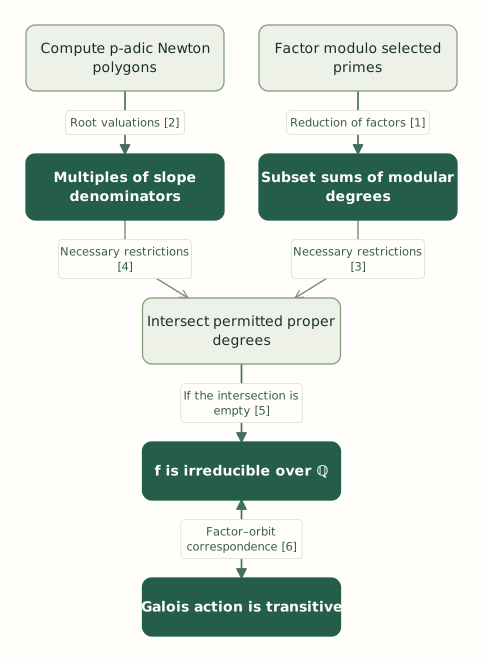
→ deduction or information flow↔ equivalence
If the irreducible modular factor degrees at a prime , repeated according to multiplicity, are , every proper rational factor has degree in
If the Newton edges at a prime have reduced slopes , with , and horizontal lengths , the corresponding restriction is
Thus proves irreducibility. One may use either kind of test alone. These are necessary degree restrictions; they do not assert that each permitted degree actually occurs. Squarefree reduction is unnecessary for this argument, but modular multiplicities must be counted.
The quartic example above has and . Two reducible reductions therefore certify rational irreducibility. The degree-six exponential example gives the parallel Newton-polygon certificate , .
Inspect all 6 connections and exact references
| Connection | Statement and source |
|---|---|
| 1Factor modulo selected primes → Subset sums of modular degreesDeduction | Gauss’s lemma and monicity preserve the degree of every rational factor after reduction; its degree is a subset sum, counting modular factors with multiplicity.
|
| 2Compute p-adic Newton polygons → Multiples of slope denominatorsDeduction | On an edge of reduced slope −a/b, each local factor uses a multiple of b roots, bounded by the edge length.
|
| 3Subset sums of modular degrees → Intersect permitted proper degreesConstruction / input | Intersect the degree sets supplied by the selected modular factorizations. |
| 4Multiples of slope denominators → Intersect permitted proper degreesConstruction / input | Include the degree sets supplied by every selected Newton polygon in the same intersection. |
| 5Intersect permitted proper degrees → f is irreducible over ℚDeduction | A proper rational factor would have a positive degree below n belonging to every displayed degree set, contradicting an empty intersection.
|
| 6f is irreducible over ℚ ↔ Galois action is transitiveEquivalence | For a separable polynomial, irreducible factors correspond to Galois orbits on the roots; one factor is equivalent to one orbit.
|
Sources and scope checked .
Questions
Does every irreducible rational polynomial have an irreducible reduction?
Scope. Separable irreducible polynomials over Q; good primes preserve degree and give squarefree reduction.
No. For a polynomial of degree , an irreducible reduction at a good prime exists exactly when its Galois group contains an -cycle. The polynomial is a counterexample: it is irreducible over , and its Klein four-group contains no 4-cycle.
References 2
Related topics
Connected diagrams
- How do two modular factorizations determine S₅? · Classical
- Central-binomial sections: exact groups and prime reductions · Claimed
- Positive Laguerre parameters: a proposed complete classification · Claimed
Foundations: polynomials, fields, and Galois groups
Gauss’s lemma gives integral factors from rational factors.
Contrasts withNewton polygons and Galois groups
Valuations give further restrictions when reduction has repeated factors.
Supplies examples forFrobenius and factorization modulo primes
Squarefree modular factorizations give Frobenius cycle types.
UsesIrreducibility over finite fields
Finite-field irreducibility tests verify the modular factors.
References
- Irreducibility tests in Q[T]
Conrad, Keith. Author-hosted expository note.
Read the source - Polynomials
Prasolov, Victor V. Springer, Algorithms and Computation in Mathematics, vol. 11, 2004.
Read the source - An irreducible that factors modulo all primes
Conrad, Keith. Author-hosted expository note.
Read the source - Chebotarëv and his density theorem
Stevenhagen, Peter and Lenstra, Jr., Hendrik W. The Mathematical Intelligencer, 18(2), 26–37, 1996.
Read the source - Schönemann–Eisenstein–Dumas-type irreducibility conditions that use arbitrarily many prime numbers
Bonciocat, Nicolae Ciprian. Communications in Algebra, 43(8), 3102–3122, 2015.
Read the source - On the Galois group of generalized Laguerre polynomials
Hajir, Farshid. Journal de théorie des nombres de Bordeaux, 17(2), 517–525, 2005.
Read the source - Galois groups as permutation groups
Conrad, Keith. Author-hosted expository notes.
Read the source
Comments
Any comments are welcome. Comments appear after the site owner approves them. Privacy policy.