Overview
- Must the three Galois-group proportions converge?
- Can the set of degrees with symmetric group be prescribed?
- Which coefficient conditions are claimed to give symmetric group in density one?
- What is claimed for binomial and Catalan sections?
Katz–Rivin questions
Let , with every , and put . For , classify the natural root action as , , or other; a repeated-root section belongs to the last class. Let be the corresponding counts through degree , divided by .
Katz–Rivin ask whether these proportions always converge and, when they do, whether the third limit must be zero or one. Their first question also asks which series have convergent proportions. Write for the limits when they exist.
The 2026 results below are preprint claims. Their full proofs have not been independently verified here; all Nguyen-Dang locators refer to version 3.
References 2
- KatzRivinSpeculations · Questions 1.1–1.2, pp. 1–2Source
- NguyenDang2026Taylor · §1.1; Theorems A–ESource version and statement recorded; the full proof has not been independently audited.Source
Prescribing the symmetric degrees
Preprint theorem (Nguyen-Dang, Theorem A)
For any set , there is an entire function
such that
The second action fixes one root and permutes the other roots arbitrarily. Its fixed root is a negative integer. Every section has distinct negative real roots, and has order zero.
If has density , the frequency triple is . If has no density, the first and third proportions fail to converge. Thus the proposed construction answers both universal questions negatively. It does not classify the series for which convergence holds.
The preprint also claims control of every consecutive coefficient block after its initial power of is removed: each proper block of degree at least two has full symmetric group. The splitting fields of these segments and of the full sections of degree at least two are jointly linearly disjoint over .
References 1
- NguyenDang2026Taylor · Theorem A, pp. 2–3; Corollary 7.6Source
Construction
Choose one coefficient at a time. Reversal turns the new coefficient into a constant parameter:
The construction arranges simple critical points with distinct critical values. These conditions give symmetric groups before specialization. Hilbert irreducibility supplies rational specializations with the required groups and field disjointness. Specializing after adjoining one root produces the fixed-root alternative.
The choices can be positive and arbitrarily small, with and . The first inequality controls real roots; the second gives convergence on the whole complex plane and order zero. Real-rootedness and rapid coefficient decay therefore coexist with arbitrary symmetric-degree patterns in the stated construction.
References 1
- NguyenDang2026Taylor · §1.4; Lemmas 2.2–2.6 and §2Source
Example
A simpler zero–one counterexample in the same preprint is
Proposition 6.2 states that every even section has group , while every odd section of degree at least three has the factor . Hence its frequency triple is . For instance,
The quadratic has discriminant . This rational function illustrates the zero–one question; it is different from the entire functions constructed above.
References 1
- NguyenDang2026Taylor · Proposition 6.2 and Corollary 6.3, pp. 32–33Source
A condition on coefficient denominators
Preprint theorem (Nguyen-Dang, Theorem B)
Fix in lowest terms, , a constant , and a number field . Let
Assume each multiplier is a -adic unit at every prime . Then, for all sufficiently large , is irreducible over and its group contains . Odd degrees have group , and, for every ,
The threshold and implied constant are uniform in the multipliers.
Primes larger than the degree produce two primitive Newton edges and inertia cycles of lengths . Several primes exclude proper factors and block systems. A permutation-group classification gives -containment, and a quadratic large sieve bounds the remaining degrees. The nonintegral hypothesis on is essential to this argument.
References 1
- NguyenDang2026Taylor · Theorem B; §§3–4, especially §§4.5–4.6The containment step invokes Müller’s classification of primitive groups with a two-cycle element.Source
Nonintegral binomial powers
For fixed , put
These are the sections of . Wei’s preprint claims the eventual group classification over . Nguyen-Dang’s Theorem C extends it to each fixed number field : for sufficiently large ,
Here denotes the nonzero squares. An affine substitution gives the reciprocal-coefficient form above. The discriminant then determines the group.
Theorem C also states that the number of exceptions to through degree is , with an explicit constant. Thus the symmetric degrees have density one, even when infinitely many alternating degrees occur. The exponent is fixed throughout; this is not a uniform all-parameter classification in small degree.
References 2
- Wei2026JacobiPrimeWitnesses · Theorem A and Corollary 9.4Wei uses J_n(x,y); the parameter here is y=s−1.Source
- NguyenDang2026Taylor · Theorem C; §§4.9–4.10; formula (4.16)Source
Central-binomial sections
Let . Wei’s preprint claims all-degree irreducibility and the eventual group formula. Nguyen-Dang’s Theorem D states the formula in every degree :
For the monic reciprocal , it also states Sun’s criterion: an irreducible reduction modulo a prime exists exactly outside those exceptional degrees. In the permitted degrees, these primes have relative natural density among all primes.
Example
Here is an exact certificate. Set
Direct expansion gives . The Newton polygons of at and have vertices
They restrict a proper rational factor to degree , respectively degree or . Hence , and therefore , is irreducible. Moreover,
The cubic has no root in , giving a 3-cycle. The discriminant is , so transitivity and this cycle force . Every prime reduction is reducible: an irreducible quartic reduction would supply an odd 4-cycle.
References 3
- Wei2026JacobiPrimeWitnesses · Theorem B(i), (ii), (iv); Remark 9.6Source
- NguyenDang2026Taylor · Theorem D; §4.11Source
- Sun2013CatalanGroups · OEIS A224416, Comments, conjecture (ii)Source
Connections and evidence
Claimed · preprintCentral-binomial sections: exact groups and prime reductions
A complete degree classification separates from and determines exactly when an irreducible reduction can occur.
Scope. For , every integer , over ; prime reductions concern the monic reciprocal . The all-degree group classification is a preprint claim.
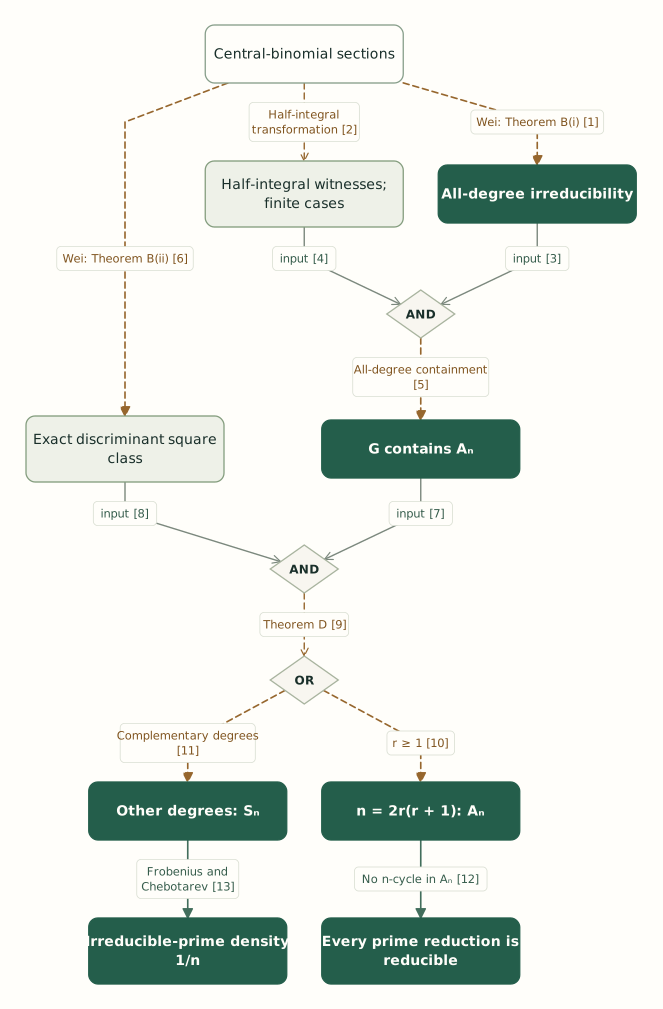
→ deduction or information flow preprint claimAND joint hypothesesOR alternatives
For the central-binomial sections , Wei’s preprint states irreducibility in every degree and the exact square-discriminant condition. Theorem D of Nguyen-Dang’s version 3 claims the complete group classification
For the monic reciprocal , an irreducible reduction modulo a prime exists exactly in the symmetric cases. Such primes have relative natural density .
The distinction has a group-theoretic explanation. An irreducible reduction corresponds to an -cycle. Every exceptional degree is even, so an -cycle is odd and cannot lie in . In , precisely of the permutations are -cycles. Thus rational irreducibility can coexist with reducibility modulo every prime.
Inspect all 13 connections and exact references
| Connection | Statement and source |
|---|---|
| 1Central-binomial sections → All-degree irreducibilityDeduction · preprint | Wei’s theorem supplies rational irreducibility in every positive degree.
|
| 2Central-binomial sections → Half-integral witnesses; finite casesConstruction / input · preprint | An affine transform has coefficients (−1)^j binomial(n,j)/(2j+1), exposing prime witnesses; the degree-six case is checked separately.
|
| 3All-degree irreducibility → ANDConstruction / input | Transitivity must be combined with the local witness argument. |
| 4Half-integral witnesses; finite cases → ANDConstruction / input | The witness argument and its finite cases supply group-theoretic information. |
| 5AND → G contains AₙDeduction · preprint | Proposition 4.13 and the separate degree-six argument yield Aₙ containment for every n ≥ 1.
|
| 6Central-binomial sections → Exact discriminant square classDeduction · preprint | For n ≥ 2 the discriminant is a square exactly when n=2r(r+1), r ≥ 1; degree one is handled directly.
|
| 7G contains Aₙ → ANDConstruction / input | Alternating containment limits the possible groups to Aₙ and Sₙ. |
| 8Exact discriminant square class → ANDConstruction / input | The square class decides which group occurs. |
| 9AND → ORConstruction / input · preprint | The selected degree condition separates the two cases in the complete classification.
|
| 10OR → n = 2r(r + 1): AₙDeduction · preprint | The exceptional degrees have group Aₙ and are all divisible by four.
|
| 11OR → Other degrees: SₙDeduction · preprint | Every other positive degree has group Sₙ, including degree one.
|
| 12n = 2r(r + 1): Aₙ → Every prime reduction is reducibleDeduction | An irreducible degree-n reduction would give an n-cycle; n is even in this branch, so that cycle would be odd.
|
| 13Other degrees: Sₙ → Irreducible-prime density 1/nDeduction | The n-cycles occupy a proportion 1/n of Sₙ, giving the stated relative natural density among primes.
|
Sources and scope checked .
Catalan sections
Write and . Seki’s preprint states irreducibility for every . Nguyen-Dang’s Theorem E states the stronger conclusion
The proof starts from Seki’s transitivity result. Inertia and estimates for sums of roots exclude proper block systems; a long cycle gives alternating containment, and an odd inertia permutation gives the symmetric group.
Theorem E also gives for , where is the largest rational prime ramified in the fixed number field , with . Sun’s separate bound for the least prime giving an irreducible reduction of remains open in the cited sources.
References 3
- Seki2026Catalan · Theorem 1.1; §§2–4The preprint proves irreducibility but explicitly does not address the full-group conjecture.Source
- NguyenDang2026Taylor · Theorem E; §5; §7.16Source
- Sun2013CatalanGroups · OEIS A224416, Comments, conjecture (i)Source
Connections and evidence
Claimed · preprintCatalan sections: factor reflection, resultants, and full symmetric groups
The irreducibility proof combines root geometry with an integer resultant; a later preprint adds the group in every degree.
Scope. For , every integer , over . Both all-degree assertions cited here are preprint claims.
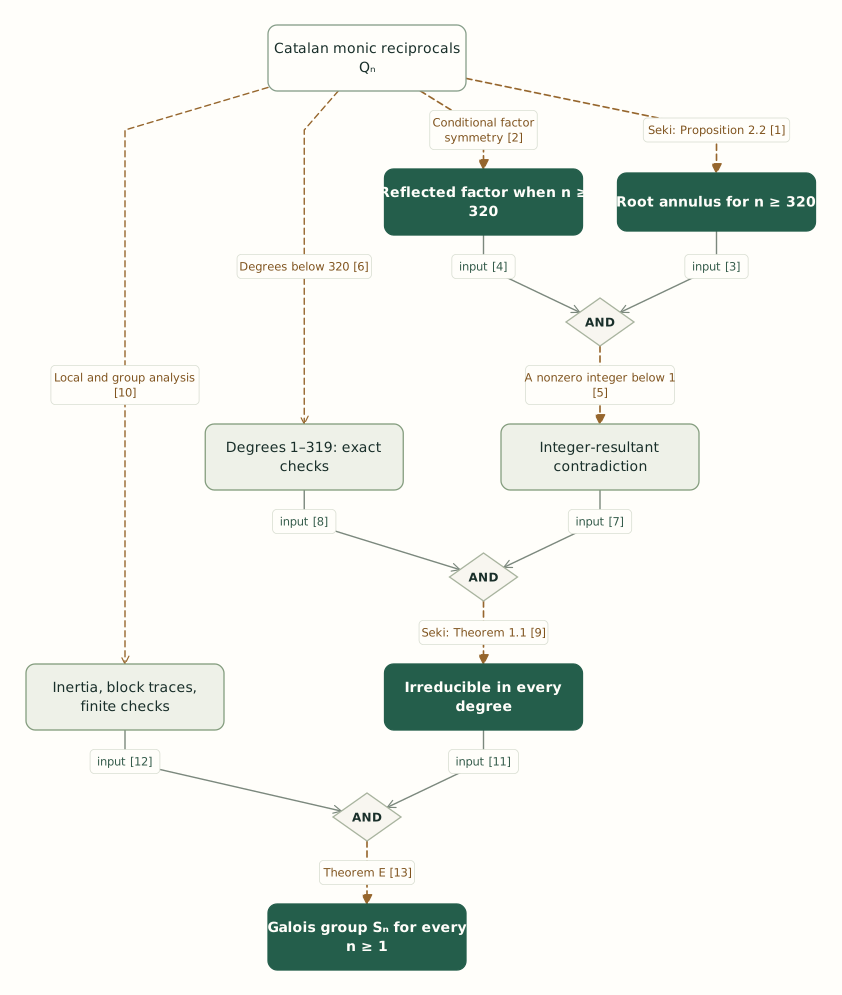
→ deduction or information flow preprint claimAND joint hypotheses
For the Catalan sections , put . Seki’s Theorem 1.1 states that every , , is irreducible over .
For , roots of satisfy . A proper factorization would supply a monic integral factor invariant under reflection , up to sign. With , these two facts force
impossible for a nonzero integer. The complementary degrees are handled by finite checks.
Theorem E of Nguyen-Dang’s version 3 further claims the complete group result
Its proof combines transitivity with local inertia and block-trace arguments.
Inspect all 13 connections and exact references
| Connection | Statement and source |
|---|---|
| 1Catalan monic reciprocals Qₙ → Root annulus for n ≥ 320Deduction · preprint | For n ≥ 320 every root of the monic reciprocal lies strictly between radii 31/8 and 4.
|
| 2Catalan monic reciprocals Qₙ → Reflected factor when n ≥ 320Deduction · preprint | For n ≥ 320, a hypothetical proper factorization has a monic factor F satisfying F(4−X)=(−1)^deg(F)F(X).
|
| 3Root annulus for n ≥ 320 → ANDConstruction / input | The annulus bounds both a root of F and its reflected partner. |
| 4Reflected factor when n ≥ 320 → ANDConstruction / input | The reflected factor is obtained only under the temporary assumption of reducibility. |
| 5AND → Integer-resultant contradictionDeduction · preprint | The hypothetical factor gives 0 < |Res(F,X²−4X+16)| < 1, contradicting integrality and excluding reducibility for n ≥ 320.
|
| 6Catalan monic reciprocals Qₙ → Degrees 1–319: exact checksConstruction / input · preprint | The paper combines its large-degree argument with the already computed small-degree irreducibility checks.
|
| 7Integer-resultant contradiction → ANDConstruction / input | The contradiction covers n ≥ 320. |
| 8Degrees 1–319: exact checks → ANDConstruction / input | The finite checks cover the complementary positive degrees. |
| 9AND → Irreducible in every degreeDeduction · preprint | Together the two degree ranges give irreducibility for every n ≥ 1.
|
| 10Catalan monic reciprocals Qₙ → Inertia, block traces, finite checksConstruction / input · preprint | The later proof studies tame inertia, possible block systems and root traces, and supplies small-degree group certificates.
|
| 11Irreducible in every degree → ANDConstruction / input | Irreducibility supplies transitivity for the group argument. |
| 12Inertia, block traces, finite checks → ANDConstruction / input | The local permutations and block analysis supply the information beyond transitivity. |
| 13AND → Galois group Sₙ for every n ≥ 1Deduction · preprint | The joint argument establishes primitivity, alternating containment and an odd permutation, with finite certificates in the small degrees.
|
Sources and scope checked .
Questions
Must all three Taylor Galois proportions converge?
Scope. Every coefficient is a nonzero rational number; degrees n≥3 and the natural root actions.
Theorem A prescribes the set of symmetric degrees. Choosing a set without a natural density gives the claimed counterexample, even for an entire function with positive rational coefficients and simple negative roots in every section. The structural part of Katz–Rivin’s question remains separate.
References 2
- KatzRivinSpeculations · Question 1.1Source
- NguyenDang2026Taylor · Theorem A; Corollary 7.6Source
Must the limiting proportion of other groups be zero or one?
Scope. A rational-coefficient Taylor sequence for which all three frequencies exist.
Theorem A gives every triple , . Proposition 6.2 gives the rational-function example with triple .
References 2
- KatzRivinSpeculations · Question 1.2Source
- NguyenDang2026Taylor · Theorem A and Proposition 6.2Source
Do the frequencies converge for every rational generating function?
Scope. A fixed f∈Q(x) regular at zero, with every Taylor coefficient nonzero.
The preprint leaves this question open, including the class . For ,
This identity connects the question to sparse polynomials with a growing exponent. The arbitrary-coefficient construction does not settle it.
References 1
- NguyenDang2026Taylor · §7.16, “Rational functions”, p. 46Source
Can the frequencies fail to converge when all sufficiently large sections are irreducible?
Scope. A series in Q[[x]] with nonzero coefficients and eventually irreducible sections.
The constructed nonconvergent examples use reducible sections. The preprint asks whether one can instead arrange nonconvergence among transitive groups, for example by alternating between symmetric and alternating groups. Prescribing arbitrary alternating degrees is also left open.
References 1
- NguyenDang2026Taylor · §7.16, “Irreducible nonconvergence and alternating prescriptions”, p. 46Source
Is the least irreducible-reduction prime at most n²+n+5?
Scope. Every n≥1; the monic reciprocal Q_n(x)=Σ_{j=0}^n c_j x^(n−j) of the Catalan section.
Sun conjectures a prime for which is irreducible. Knowing the group is gives infinitely many such primes, but does not give this explicit bound.
References 2
- Sun2013CatalanGroups · OEIS A224416, Comments, conjecture (i)Source
- NguyenDang2026Taylor · §7.16, “Classical sections and smaller thresholds”, p. 45Source
Does each central-trinomial section have a small irreducible-reduction prime?
Scope. Every n≥1; central-trinomial coefficients T_j=[z^j](z²+z+1)^j.
Sun asks whether
is irreducible modulo some prime . This would imply rational irreducibility and an -cycle in the Galois group. It is a separate conjecture from the Catalan and central-binomial statements.
References 1
- Sun2013CatalanGroups · OEIS A224416, Comments, conjecture (iii)Source
Related topics
Taylor polynomials
Schur’s exponential example supplies the frequency triple (3/4,1/4,0).
UsesSpecialization and Hilbert irreducibility
Hilbert irreducibility chooses successive coefficients with prescribed groups.
UsesNewton polygons and Galois groups
A prime dividing one denominator supplies two local factor degrees and inertia cycles.
UsesDiscriminants, parity, and ramification
The square class distinguishes the alternating and symmetric possibilities.
Connects toSparse polynomials and factor reversal
Sections of P(x)/(1−x) lead to P(x)−P(1)x^(n+1).
Linked from 1 articles
References
- Speculations in Galois Theory
Katz, Nicholas M. and Rivin, Igor. Laumon volume (online contribution).
Read the source - Galois groups of Taylor polynomials: prescriptions and arithmetic families
Nguyen-Dang, Khai-Hoan. Hexagon preprint, 2026.
Read the source - Prime Witnesses and Eventual Alternating–Symmetric Galois Groups in a Jacobi Family
Wei, Dongsheng. Zenodo, 2026.
Read the source - A224416: least prime giving an irreducible reduction of a reversed Catalan section
Sun, Zhi-Wei. The On-Line Encyclopedia of Integer Sequences, 2013.
Read the source - Irreducibility of truncations of the Catalan generating function
Seki, Shin-ichiro. arXiv preprint, 2026.
Read the source - Galois groups over Q and factorizations mod p
Conrad, Keith. Author-hosted expository note.
Read the source - Chebotarëv and his density theorem
Stevenhagen, Peter and Lenstra, Jr., Hendrik W. The Mathematical Intelligencer, 18(2), 26–37, 1996.
Read the source
Comments
Any comments are welcome. Comments appear after the site owner approves them. Privacy policy.