Overview
- For fixed rational , what is known about as grows?
- For fixed , how many parameters give a group smaller than ?
- Which parameters force a zero root or a square discriminant?
Definition and normalization
For and , set
The generalized binomial coefficient is a polynomial in . For real , these polynomials form a classical orthogonal family; the arithmetic question also makes sense outside that range. Their monic normalization is .
If in lowest terms, , then an integral monic normalization with the same splitting field is
The product permits valuation estimates using an arithmetic progression.
Fixed parameter
Theorem (Filaseta–Lam; Hajir)
Fix . For every sufficiently large , depending on , the polynomial is irreducible over and its group contains . It equals or according to whether its discriminant is a rational square.
Filaseta–Lam supply eventual irreducibility. Hajir obtains a large prime divisor of a Newton-slope denominator, then uses a permutation-group criterion. Irreducibility supplies the transitivity required by that criterion.
References 2
- FilasetaLam2002Eventual irreducibility for a fixed rational parameter outside the negative integers.Source
- Hajir2005 · Theorems 1.1 and 2.2Eventual alternating containment and the Newton-index criterion.Source
Connections and evidence
Claimed · preprintPositive Laguerre parameters: a proposed complete classification
A recent preprint claims every irreducible and reducible case for . The exact exceptions are checkable; a proof-audit concern in the finite-pruning argument is recorded below.
Scope. Over , for every integer and integer . The conclusion is an irreducibility classification, not a Galois-group classification.
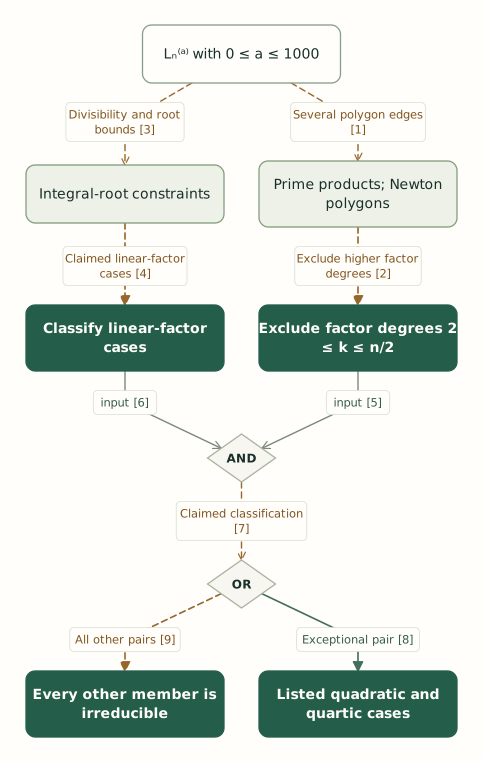
→ deduction or information flow preprint claimAND joint hypothesesOR alternatives
For the standard Laguerre polynomial , with integers and , Theorem 1.1 of the October 2026 preprint states irreducibility over except exactly when
Each exceptional member has a linear factor. The quadratic family is visible directly:
The proposed proof treats higher factor degrees and linear factors separately, using several Newton-polygon edges and integral-root constraints. This theorem does not determine the Galois groups.
The two quartic exceptions can also be checked directly:
Proof-audit boundary. In v1, Lemma 6.1(iii) states simultaneous valuation bounds where its proof gives alternatives, and additional proof branches are absent from the statement. Lemmas 6.5–6.6 use these restrictions to prune finite cases. Exhaustiveness under the weaker conditions has not been verified. This concerns the proof as written; it is not a counterexample to the classification.
Inspect all 9 connections and exact references
| Connection | Statement and source |
|---|---|
| 1Lₙ⁽ᵃ⁾ with 0 ≤ a ≤ 1000 → Prime products; Newton polygonsConstruction / input · preprint | The proof combines earlier small-parameter results with prime-product bounds and several edges of the Newton polygon for the enlarged range.
|
| 2Prime products; Newton polygons → Exclude factor degrees 2 ≤ k ≤ n/2Deduction · preprint | The preprint claims exclusion of every proper factor degree between two and half the degree; this arrow records its proposed argument.
|
| 3Lₙ⁽ᵃ⁾ with 0 ≤ a ≤ 1000 → Integral-root constraintsConstruction / input · preprint | The monic integral normalization makes every rational root integral, and the paper imposes sharper constraints on such a root.
|
| 4Integral-root constraints → Classify linear-factor casesDeduction · preprint | The preprint claims precisely the listed linear-factor cases. The statement/proof mismatch in Lemma 6.1(iii), used for finite pruning, remains a proof-audit boundary.
|
| 5Exclude factor degrees 2 ≤ k ≤ n/2 → ANDConstruction / input | The higher-degree exclusion must be combined with the linear-factor analysis. |
| 6Classify linear-factor cases → ANDConstruction / input | Knowing the linear-factor cases alone would not exclude a higher-degree factorization. |
| 7AND → ORConstruction / input · preprint | If both exclusion arguments are complete, they exhaust all possible proper rational factors; the finite-pruning concern is stated below.
|
| 8OR → Listed quadratic and quartic casesDeduction | The displayed quadratic identity and the quartic factorizations verify reducibility of every listed pair directly; this direction does not depend on completeness of the preprint proof.
|
| 9OR → Every other member is irreducibleDeduction · preprint | Theorem 1.1 claims irreducibility outside the exception list; this conclusion retains the proof-audit limitation noted below.
|
Sources and scope checked .
Small rational parameters
Theorem (Laishram–Shorey)
Let . For every , is irreducible over , except when .
The proof combines Newton polygons with large prime divisors of arithmetic-progression products.
Example
The exception is explicit in arXiv:1306.0736v2. The power-substitution statement in the cited theorem requires a low-degree qualification: although is irreducible, .
References 1
- LaishramShorey2016III · Theorem 1 and §8; arXiv:1306.0736v2The ordinary Laguerre assertion only is used; see the explicit boundary example for power substitutions.Source
Fixed degree
Fix a number field and a degree . Then all but finitely many give an irreducible polynomial with Galois group over . Hajir–Wong prove this using intermediate covers and finiteness of rational points on curves of sufficiently high genus.
The exceptional set depends on the fixed degree and number field. Its finiteness is stronger than the conclusion of Hilbert irreducibility.
References 1
- HajirWong2006 · Theorem 1(a)The finite exceptional set for fixed n≥10 and fixed number field K.Source
Discriminant
Schur's product formula for the monic normalization is
Example (α=0, n=3)
Here . Eisenstein at proves irreducibility. Its discriminant is , a nonsquare. An irreducible cubic has group or ; therefore this group is .
The product also determines the parameters with repeated roots: for degree , the exceptional values are . Separability and irreducibility are separate properties; at there is already a simple rational root at zero.
Negative integer parameters
Remark
For integers and , coefficient comparison gives
For example, . Thus a fixed negative integer parameter supplies a forced zero for every sufficiently large degree. This explains the negative-integer exclusion in the fixed-parameter theorem.
The varying parameter gives , the exponential truncation. Here the parameter depends on the degree, so the fixed-parameter obstruction does not apply.
Alternating groups
For every with , the polynomial is irreducible and has group . Together with Schur's other Laguerre specializations, this realizes every in this family. At , is split and its group is the trivial group ; irreducibility is not claimed there.
For integer parameters, Banerjee–Filaseta–Finch–Leidy classify nonzero square discriminants. Banerjee–Bera subsequently study the actual alternating Galois groups for integer , up to finitely many exceptions. The square-discriminant classification and the group classification answer different questions.
References 3
- FilasetaKiddTrifonov2012 · Theorem 1 and Corollary 1Source
- BanerjeeFilasetaFinchLeidy2013Classification of nonzero square discriminants.Source
- BanerjeeBera2022 · Abstract and IntroductionThe α≠n restriction is essential to the stated classification scope.Source
Questions
Which explicit varying-parameter sequences have irreducible Laguerre polynomials?
Scope. over Q, with the sequence α_n specified in advance.
Eventual irreducibility for each fixed parameter does not imply irreducibility when the parameter changes with the degree. A sequence of parameters requires uniform control of factor degrees or a separate argument using its coefficient products.
References 2
Are there only finitely many exceptional parameters in fixed degree ?
Scope. Any fixed number field and fixed .
Yes: the parameters in for which the polynomial is reducible or has Galois group different from form a finite set. The theorem does not automatically provide an effective list of those parameters.
References 1
- HajirWong2006 · Theorem 1(a) and Remark 1Source
Related topics
Connected diagrams
Browse all diagrams →Newton polygons and Galois groups
Arithmetic-progression products determine coefficient valuations and Newton slopes.
UsesSpecialization and Hilbert irreducibility
Fixed-degree parameter families are studied through covers and exceptional specializations.
Supplies examples forTaylor polynomials
The parameter −n−1 gives the exponential truncation.
GeneralizesHermite, Bessel, and Legendre polynomials
Hermite and Bessel identities connect to Laguerre parameters and substitutions.
Connects toCapelli’s theorem and polynomial composition
Power substitutions can create factors even when the original Laguerre polynomial is irreducible.
Related familyLaguerre polynomials with negative parameters
A negative parameter varying with the degree gives Hajir’s two-parameter conjectures.
References
- On the Galois group of generalized Laguerre polynomials
Hajir, Farshid. Journal de théorie des nombres de Bordeaux, 17(2), 517–525, 2005.
Read the source - On the irreducibility of the generalized Laguerre polynomials
Filaseta, Michael and Lam, Tsit-Yuen. Acta Arithmetica, 105(2), 177–182, 2002.
Read the source - Irreducibility of generalized Hermite–Laguerre polynomials III
Laishram, Shanta and Shorey, Tarlok N. Journal of Number Theory, 164, 303–322, 2016.
Read the source - Specializations of one-parameter families of polynomials
Hajir, Farshid and Wong, Siman. Annales de l’Institut Fourier, 56(4), 1127–1163, 2006.
Read the source - Affektlose Gleichungen in der Theorie der Laguerreschen und Hermiteschen Polynome
Schur, Issai. Journal für die reine und angewandte Mathematik, 165, 52–58, 1931.
Read the source - Laguerre polynomials with Galois group A_m for each m
Filaseta, Michael and Kidd, Travis and Trifonov, Ognian. Journal of Number Theory, 132, 776–805, 2012.
Read the source - On classifying Laguerre polynomials which have Galois group the alternating group
Banerjee, Pradipto and Filaseta, Michael and Finch, Carrie E. and Leidy, J. Russell. Journal de théorie des nombres de Bordeaux, 25(1), 1–30, 2013.
Read the source - Classifying families of orthogonal polynomials having Galois group the alternating group
Banerjee, Pradipto and Bera, Ranjan. Journal of Number Theory, 240, 31–49, 2022.
Read the source - Algebraic properties of a family of generalized Laguerre polynomials
Hajir, Farshid. Canadian Journal of Mathematics, 61(3), 583–603, 2009.
Read the source - Irreducibility of Generalised Laguerre Polynomials for Large Integer Parameters
Das, Drishya T. and Dutta, Saheli and Laishram, Shanta and Nair, Saranya G. arXiv preprint, 2026.
Read the source
Comments
Any comments are welcome. Comments appear after the site owner approves them. Privacy policy.