Overview
- Which normalizations of Hermite and Bessel polynomials are irreducible in every degree?
- What do Stieltjes’ conjecture and the Legendre group conjecture assert?
- How do opposite root pairs affect the full Galois group?
- What is known about the nonzero roots of Hermite Wronskians?
- Can distinct Legendre polynomials share a nonzero root?
Arithmetic properties
Orthogonal polynomials occur in approximation, differential equations, and spectral problems. Their recurrence and differential identities often give exact coefficients and simple real roots. Neither property alone forces irreducibility over : a polynomial can have distinct real algebraic roots and still factor rationally.
Schur's work on Laguerre and Hermite polynomials established local arithmetic methods for such families. The all-degree irreducibility theorems for Hermite and Bessel polynomials are classical or published results. For Legendre polynomials, the general theorem is claimed in a recent preprint.
References 3
- Schur1931Foundational algebraic study of Laguerre and Hermite families.Source
- FilasetaTrifonov2002All-degree Bessel irreducibility.Source
- CullinanHajir2014 · IntroductionStieltjes’ conjecture and the remaining Legendre problem in this source.Source
Hermite polynomials
For the physicists' Hermite convention , one has
The odd polynomial has a forced factor ; all remaining roots occur in opposite pairs. A theorem concerning alone does not automatically determine the quadratic extensions obtained when square roots of its roots are adjoined.
Example
Here . Its pair polynomial is , with roots . The pair field has degree two; the full splitting field also requires square roots of these roots. The same construction applies in higher degree.
Theorem (Schur)
For every , the physicists' polynomials and are irreducible over . This uses the normalization above. Rescaling the variable by an irrational number need not preserve irreducibility over : for example, is irreducible, whereas the probabilists' polynomial is reducible.
References 3
- CullinanHajirSell2009 · §1The two Hermite–Laguerre identities.Source
- Schur1931The classical arithmetic context.Source
- LaishramShorey2016III · IntroductionRestates Schur’s theorem for L_n^(±1/2)(x²) and the physicists’ Hermite normalization.Source
Hermite Wronskians
Define the monic probabilists' polynomials by . For a partition , put and
Write , where is the multiplicity at zero. Grosu–Grosu prove that is irreducible for or , for , and when is a square.
At , , so , a unit, hence not irreducible. Their methods combine Newton-slope bounds with Schur-type congruences. Irreducibility implies simple nonzero roots, connecting arithmetic to differential equations. Irreducibility does not hold for every partition: . This concerns the displayed probabilists' normalization.
References 1
- GrosuGrosu2021 · Definition 1, Theorems 1–3 and 7–8, and the discussion after Proposition 6 (arXiv:2007.00065v1)Source
Bessel polynomials
Theorem (Filaseta–Trifonov)
Let , and let satisfy . Then
is irreducible over . Taking every proves the irreducibility of the Bessel polynomial in every positive degree.
The method bounds possible factor degrees by Newton polygons and prime divisors of factorial products. The valuation bounds allow the stated integral multipliers on the intermediate coefficients.
Example
The cubic Bessel polynomial is . Modulo it is , which has no root and is therefore irreducible. Its discriminant is , a nonsquare, so its Galois group is .
References 1
- FilasetaTrifonov2002 · Main theorem and §2All-degree coefficient-perturbation theorem and the Newton-polygon mechanism.Source
Generalized Bessel polynomials
Banerjee–Bera study irreducibility and Galois groups for a generalized Bessel family. Their 2020 paper has a 2021 corrigendum, which must be consulted with the original. These references concern additional parameters and do not change the all-degree theorem for the ordinary Bessel polynomials above.
References 2
- BanerjeeBera2020Grosswald · Publisher abstractFull parameter-dependent theorem statements were not checked and are not asserted here.Source
- BanerjeeBera2021GrosswaldCorrection · Published correction, pp. 426–428Bibliographic record verified; full correction not accessed.Source
Legendre polynomials
Define . Since , the factor is forced at odd indices. Stieltjes' conjecture, as presented by Cullinan–Hajir, asks whether and are irreducible over for every . Their Galois-group questions concern these even polynomials and the corresponding signed-permutation action.
Example
After scaling, , which is Eisenstein at . Its pair polynomial has discriminant . Thus its pair field is . This calculation proves irreducibility in degree four only.
Finite check
Exact modular certificates for the pair polynomials, together with norm witnesses for their quadratic lifts, verify that is irreducible over for . An independent verifier reconstructed the coefficients from the Legendre recurrence and checked the certificates. This finite range does not establish an all-degree theorem or determine the Galois groups.
References 3
- CullinanHajir2014 · §1Stieltjes’ irreducibility conjecture and parity-reduced Galois groups.Source
- CullinanHajir2014 · Lemma 1.3Norm criterion used to pass from pair irreducibility to lift irreducibility. The stated finite range was separately checked for this atlas on 12 November 2026.Source
- Deng2026Legendre · Lemma 6.2, arXiv:2609.22336v2The same finite range, 2≤n≤255, is stated here. The atlas checked this range independently by modular and norm certificates; it did not verify the preprint’s all-degree argument or Galois groups.Source
Connections and evidence
PublishedLegendre values: from prime divisibility to base-p digits
A published all-degree formula expresses through central binomial coefficients and gives a recurrence that reads the base-p digits of n.
Scope. Standard Legendre polynomials, every odd prime , and every integer . The evaluation point is the same prime p as the valuation; the distinct p=2 formula is stated below.
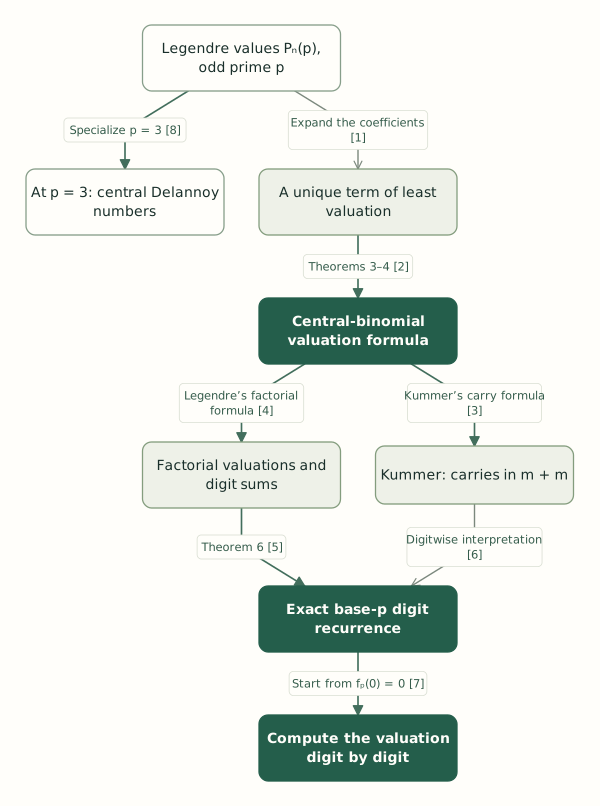
→ deduction or information flow
Let , where is prime and . For every , the published theorem gives
Kummer identifies the binomial valuation with carries in in base . Equivalently, if is the sum of the base- digits,
For every and , this yields the complete recurrence
At , is the central Delannoy number. Since , the recurrence gives , , and ; indeed , with the last factor prime to .
The prime has its own formula: . These are valuation theorems in every degree, not irreducibility criteria.
Inspect all 8 connections and exact references
| Connection | Statement and source |
|---|---|
| 1Legendre values Pₙ(p), odd prime p → A unique term of least valuationConstruction / input | The coefficient estimates identify one summand with strictly smaller p-adic valuation in the relevant parity expansion.
|
| 2A unique term of least valuation → Central-binomial valuation formulaDeduction | The least-valuation term gives the displayed formulas for even and odd degrees without cancellation.
|
| 3Central-binomial valuation formula → Kummer: carries in m + mDeduction | The valuation of the central binomial coefficient equals the number of carries in the base-p addition m+m.
|
| 4Central-binomial valuation formula → Factorial valuations and digit sumsDeduction | Writing factorial valuations as digit sums gives the all-degree digit formula in Theorem 4.
|
| 5Factorial valuations and digit sums → Exact base-p digit recurrenceDeduction | Splitting n into its last base-p digit and remaining prefix yields the two-case recurrence.
|
| 6Kummer: carries in m + m → Exact base-p digit recurrenceConstruction / input | The carry description interprets the same valuation that the recurrence computes; it is not an extra hypothesis.
|
| 7Exact base-p digit recurrence → Compute the valuation digit by digitDeduction | The recurrence evaluates fₚ(n) using the digits of n and the parity of each prefix.
|
| 8Legendre values Pₙ(p), odd prime p → At p = 3: central Delannoy numbersDeduction | The binomial identity Pₙ(3)=Σⱼ binom(n,j)binom(n+j,j) identifies the central Delannoy sequence.
|
Sources and scope checked .
A claimed proof of Stieltjes’ conjecture
Preprint claim
Zikang Deng’s September 2026 preprint claims a proof of Stieltjes’ irreducibility conjecture in every degree. Version 2 uses local and real estimates for a resultant. This is recorded as a preprint claim; the full proof has not been independently checked.
References 1
- Deng2026Legendre · Theorem 1.1, arXiv:2609.22336v2 (27 September 2026)A preprint claims a complete resolution; this atlas has not independently verified the full proof.Source
Common roots of Legendre polynomials
Preprint theorem · Kadets–Mangoubi
If is a root of , then
Their argument interpolates related polynomials 2-adically and bounds the zeros of the resulting analytic functions. The source conjectures that two distinct Legendre polynomials have no common nonzero root. This is a different question from irreducibility of each parity-normalized polynomial. The proposed all-degree irreducibility theorem would imply the common-root conjecture; Kadets–Mangoubi explicitly record that proposed theorem as a claim.
Indeed, a common nonzero root of two irreducible normalized members would force them to have the same degree. Only consecutive even and odd indices can have that degree; consecutive Legendre polynomials are coprime by their three-term recurrence.
References 2
- KadetsMangoubi2026Legendre · Conjecture 1.1, Theorem 1.2, and the remark in §1.5; arXiv:2611.09312v1, 6 November 2026Statement and version checked; the complete preprint proof has not been independently audited.Source
- Deng2026Legendre · Theorem 1.1, arXiv:2609.22336v2The stronger irreducibility statement remains listed separately as a preprint claim.Source
Methods and parameter ranges
The coefficient products of these families give explicit valuations and Newton polygons. Parity gives an action on opposite root pairs, and discriminant formulas can distinguish alternating from symmetric groups on the reduced roots. To transfer an argument between families, the change of variable must be defined over the ground field.
For Jacobi polynomials, fixing the parameters and letting the degree grow is different from fixing the degree and specializing a parameter. The former uses uniform arithmetic estimates; the latter can use covers and rational points.
References 2
- CullinanHajirSell2009A fixed-degree one-parameter Jacobi family.Source
- HajirWong2006Geometric specialization methods and the distinction between parameter regimes.Source
Trace forms
Let be monic and irreducible, with roots , and let . The trace form is the quadratic form . Put
Then . When all these minors are nonzero, their successive ratios diagonalize the trace form. Cullinan–Hajir–Young’s 2026 preprint develops continued-fraction formulas for Jacobi power-sum minors (Theorem 13) and applies them to Hasse–Witt invariants (§4). These invariants enter embedding problems for central double covers of alternating groups. They provide arithmetic information beyond the discriminant; they do not establish irreducibility for arbitrary Jacobi parameters.
Version note. The displayed formula in Theorem 6 of v1 needs a normalization correction: at it gives , whereas the definition in §1.2 gives , with . We therefore do not reproduce or use that diagonal formula here.
References 1
- CullinanHajirYoung2026 · §1.2, Theorems 6 and 13, and §4; version 1Theorem 13 and §4 give the scope summarized here. The v1 Theorem 6 normalization discrepancy is recorded explicitly; its displayed diagonal formula is not used. Rational specializations must avoid degree loss and denominator zeros.Source
Legendre Galois groups
Write , with . Cullinan–Hajir conjecture, under irreducibility of the degree- reduced polynomial, that its group is and that the group of is . The two conclusions concern different permutation actions. Their Theorem 1.9(a) verifies the first conclusion through , still assuming irreducibility. A 2026 preprint claims the full group conjecture; it has not been independently verified here.
References 2
- CullinanHajir2014 · Conjecture 1.5 and Theorem 1.9(a)Source
- NguyenDang2026Jacobi · Abstract; version 1, 22 October 2026Source
Connections and evidence
Claimed · preprintLegendre polynomials: irreducibility and all signed permutations
Two preprints claim all-degree irreducibility and the full group , combining resultant estimates with local cycles and the action on opposite root pairs.
Scope. Over , for every and , with the standard normalization and . Both all-degree inputs remain preprint claims.
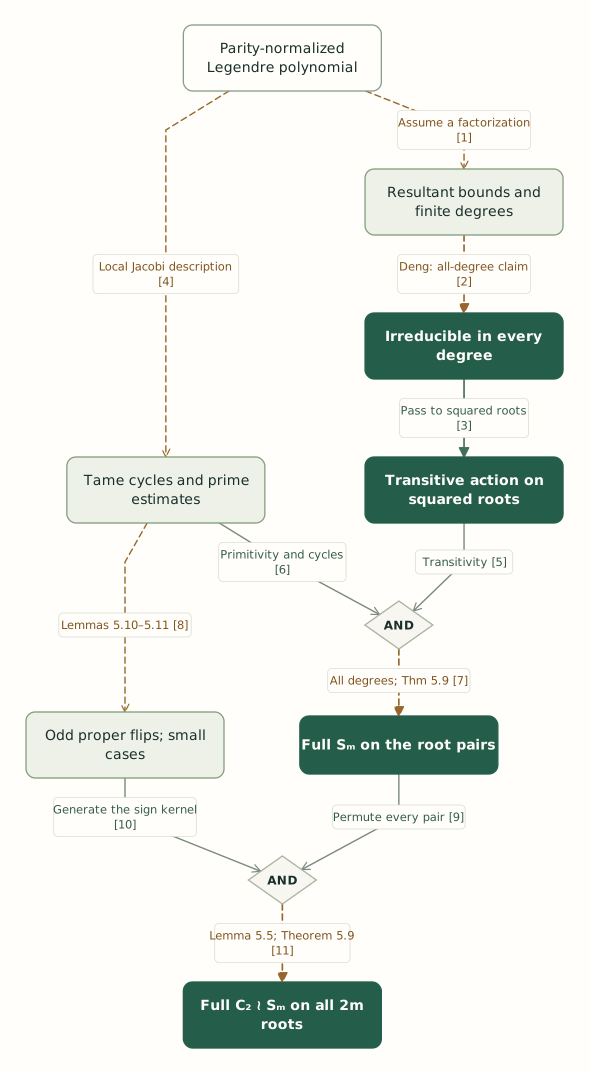
→ deduction or information flow preprint claimAND joint hypotheses
Preprint claims in every degree. Put , where and . Deng’s version 2 claims that is irreducible. Nguyen-Dang’s version 1 claims the complete group determination
The latter group acts on roots: permutes opposite pairs, and exchanges their members independently. Irreducibility alone does not determine either group. The two AND nodes show the extra inputs required.
The resultant comparison excludes factors in large degree; a finite completion is part of the irreducibility claim. On the group side, local cycles first determine the action on pairs. For , an odd proper pair flip and its conjugates generate every sign change; the three smaller pair degrees receive explicit checks.
Why the resultant bounds conflict
For , write . Deng’s Lemma 2.2 makes every rational factor of even, so every proper factorization descends to . For a nontrivial factorization, take , and let be the positive odd part of . For , the Wronskian identity and orthogonality give the upper bound below; Legendre’s differential equation and Chebyshev–Hadamard estimates give the lower bound:
These bounds contradict each other for ; the finite completion covers (Deng, Theorems 4.1, 5.1 and §6).
The source statements and these dependencies were checked. The full preprint proofs have not been independently verified, and the all-degree conclusions retain the status Claimed.
Inspect all 11 connections and exact references
| Connection | Statement and source |
|---|---|
| 1Parity-normalized Legendre polynomial → Resultant bounds and finite degreesConstruction / input · preprint | Deng compares local and real bounds for the odd part of the factor resultant, then handles the remaining degrees.
|
| 2Resultant bounds and finite degrees → Irreducible in every degreeDeduction · preprint | The claimed contradiction and finite-range completion give irreducibility of both parity-normalized families.
|
| 3Irreducible in every degree → Transitive action on squared rootsDeduction | Writing L(x)=Q(x²), irreducibility of L implies irreducibility of Q and hence transitivity on its m roots.
|
| 4Parity-normalized Legendre polynomial → Tame cycles and prime estimatesConstruction / input · preprint | The quadratic Jacobi transformation makes coefficient valuations and selected tame inertia cycles explicit.
|
| 5Transitive action on squared roots → ANDConstruction / input | Transitivity is one input to the group calculation. |
| 6Tame cycles and prime estimates → ANDConstruction / input | The local cycles and prime estimates supply the additional group-theoretic input. |
| 7AND → Full Sₘ on the root pairsDeduction · preprint | The preprint combines the published finite range with its large-degree primitivity argument and cycle criterion.
|
| 8Tame cycles and prime estimates → Odd proper flips; small casesConstruction / input · preprint | For m≥4 a suitable inertia power flips an odd proper set of pairs; the proof treats m≤3 separately.
|
| 9Full Sₘ on the root pairs → ANDConstruction / input | The full action on pairs is required before conjugating a pair flip. |
| 10Odd proper flips; small cases → ANDConstruction / input | The pair-flip input, or the explicit small-degree calculation, supplies the missing sign changes. |
| 11AND → Full C₂ ≀ Sₘ on all 2m rootsDeduction · preprint | The pair action and sign-kernel argument together yield the claimed full wreath product.
|
Sources and scope checked .
Jacobi and Gegenbauer parameters
Preprint claims
Nguyen-Dang’s Jacobi preprint also treats standard with fixed distinct nonnegative integers . Theorem 1.3 claims irreducibility and group for every sufficiently large , with an effective parameter-dependent threshold.
For integer , , and , set , using the usual Gegenbauer polynomial. Theorem 1.4 claims irreducibility of this degree- polynomial when , and when for an effective absolute . These extend the paper’s Legendre and Kaneko–Zagier claims. The full proofs have not been independently verified here.
References 1
- NguyenDang2026Jacobi · Theorems 1.3–1.4, pp. 2–3; equations (1.2)–(1.3); version 1, 22 October 2026Source
Questions
Are and always irreducible over ?
Scope. The standard Legendre polynomials and all integers m≥1.
This is Stieltjes’ conjecture in the cited 2014 paper. Deng’s September 2026 preprint claims a complete proof. The proof has not been independently verified here, so the result is recorded as a preprint claim.
References 2
- CullinanHajir2014 · §1Source
- Deng2026Legendre · Theorem 1.1, arXiv:2609.22336v2 (27 September 2026)A preprint claims a complete resolution; this atlas has not independently verified the full proof.Source
Are the Bessel polynomials irreducible in every positive degree?
Scope. over Q, n≥1.
Yes. The Filaseta–Trifonov theorem proves this and permits arbitrary integral intermediate coefficient multipliers with endpoint multipliers ±1.
References 1
- FilasetaTrifonov2002 · Main theoremSource
Are the reduced and full Legendre groups and ?
Scope. , , assuming irreducibility of the degree- pair polynomial over .
This is the two-part group conjecture of Cullinan–Hajir. It concerns the Galois groups, separately from Stieltjes’ irreducibility conjecture. A 2026 preprint claims a complete proof.
References 2
- CullinanHajir2014 · Conjecture 1.5Source
- NguyenDang2026Jacobi · AbstractSource
Are all nonzero zeros of every Hermite Wronskian simple?
Scope. Wronskians of Hermite polynomials with distinct nonnegative indices; zeros over .
Veselov’s conjecture permits a multiple zero at the origin. It asks whether the remainder is squarefree; it does not assert irreducibility. Grosu–Grosu prove it for partitions , with . Felder–Veselov–Nekrasov still state the general problem as open in 2026.
References 3
- FelderHemeryVeselov2012 · §6, Conjecture 1Source
- GrosuGrosu2021 · Conjecture 1 and Proposition 6; arXiv:2007.00065v1Source
- FelderVeselovNekrasov2026 · §5, second paragraphThe 2026 published paper explicitly states that a general proof of simplicity away from zero is still unknown.Source
Which two-part Hermite Wronskians have irreducible nonconstant remainders?
Scope. The probabilists’ normalization , where and .
Grosu–Grosu ask to extend their irreducibility results to further two-part partitions. Their results include and the diagonal when is a square. The constant remainder at is excluded. A blanket statement for all partitions would be false.
References 1
- GrosuGrosu2021 · Introduction, Theorems 1–3, and §10; arXiv:2007.00065v1Source
Can distinct Legendre polynomials share a nonzero root?
Scope. Integers , ; the Legendre polynomials .
The conjecture is that and have no common root other than the forced root at odd indices. Kadets–Mangoubi prove in their version-1 preprint that a fixed nonzero root of belongs to at most members of the sequence. Their Conjecture 1.1 asks for the stronger pairwise statement. The separate all-degree irreducibility claim would imply it; its full proof has not been independently verified here.
References 2
- KadetsMangoubi2026Legendre · Conjecture 1.1, Theorem 1.2, and §1.5 remark; v1Source
- Deng2026Legendre · Theorem 1.1; v2Proposed stronger result, not treated as settled.Source
Related topics
Connected diagrams
- When does a reciprocal polynomial have the full signed group? · Classical
- Four Jacobi families: modular forms, symmetric groups, and Jacobians · Claimed
Generalized Laguerre polynomials
Hermite identities reduce the pair polynomials to Laguerre parameters ±1/2.
UsesNewton polygons and Galois groups
Factorial products constrain factor degrees.
GeneralizesReciprocal polynomials
The actions on sign pairs and inverse pairs lie in analogous wreath products.
Applies toSpecialization and Hilbert irreducibility
Parameterized Jacobi families connect to fixed-degree specialization theorems.
Related familyKrawtchouk polynomials
Centering separates pairs of roots and leads to a reduced Galois group.
Related familyKaneko–Zagier polynomials
Four Jacobi specializations connect orthogonal polynomials and modular forms.
References
- Affektlose Gleichungen in der Theorie der Laguerreschen und Hermiteschen Polynome
Schur, Issai. Journal für die reine und angewandte Mathematik, 165, 52–58, 1931.
Read the source - The irreducibility of the Bessel polynomials
Filaseta, Michael and Trifonov, Ognian. Journal für die reine und angewandte Mathematik, 550, 125–140, 2002.
Read the source - On the Galois groups of Legendre polynomials
Cullinan, John and Hajir, Farshid. Indagationes Mathematicae, 25(3), 534–552, 2014.
Read the source - Algebraic properties of a family of Jacobi polynomials
Cullinan, John and Hajir, Farshid and Sell, Elizabeth. Journal de théorie des nombres de Bordeaux, 21(1), 97–108, 2009.
Read the source - Irreducibility of generalized Hermite–Laguerre polynomials III
Laishram, Shanta and Shorey, Tarlok N. Journal of Number Theory, 164, 303–322, 2016.
Read the source - The irreducibility of some Wronskian Hermite polynomials
Grosu, Codruţ and Grosu, Corina. Indagationes Mathematicae, 32(2), 456–497, 2021.
Read the source - On a generalization of a conjecture of Grosswald
Banerjee, Pradipto and Bera, Ranjan. Journal of Number Theory, 216, 216–241, 2020.
Read the source - Corrigendum to “On a generalization of a conjecture of Grosswald” [J. Number Theory 216 (2020) 216–241]
Banerjee, Pradipto and Bera, Ranjan. Journal of Number Theory, 222, 426–428, 2021.
Read the source - A proof of the irreducibility conjecture for Legendre polynomials
Deng, Zikang. arXiv preprint, 2026.
Read the source - Root sharing and 2-adic interpolation for Legendre polynomials
Kadets, Borys and Mangoubi, Dan. arXiv preprint, 2026.
Read the source - Specializations of one-parameter families of polynomials
Hajir, Farshid and Wong, Siman. Annales de l’Institut Fourier, 56(4), 1127–1163, 2006.
Read the source - Hasse-Witt invariants for trace forms of Jacobi polynomials
Cullinan, John and Hajir, Farshid and Young, Elisabeth. arXiv preprint, 2026.
Read the source - Arithmetic of Jacobi polynomials
Nguyen-Dang, Khai-Hoan. Hexagon preprint, 2026.
Read the source - Zeros of Wronskians of Hermite polynomials and Young diagrams
Felder, Giovanni and Hemery, Adrian D. and Veselov, Alexander P. Physica D: Nonlinear Phenomena, 241(23-24), 2131–2137, 2012.
Read the source - Harmonic Locus and Calogero-Moser Spaces
Felder, Giovanni and Veselov, Alexander P. and Nekrasov, Nikita. Communications in Mathematical Physics, 407(2), Article 22, 2026.
Read the source - Primitive permutation groups containing a cycle
Jones, Gareth A. Bulletin of the Australian Mathematical Society, 89(1), 159–165, 2014.
Read the source - On the p-adic valuations of values of Legendre polynomials
Alekseyev, Max A. and Amdeberhan, Tewodros and Shallit, Jeffrey and Vukusic, Ingrid. Research in Number Theory, 12, Article 52, 2026.
Read the source
Comments
Any comments are welcome. Comments appear after the site owner approves them. Privacy policy.