Overview
- Which four Jacobi families occur?
- What is proved about their irreducibility and Galois groups?
- What does the 2026 preprint claim?
Four Jacobi families
With the standard Jacobi convention, define
This equals . For , , and , rational changes of variable and nonzero scaling identify these four families with the Kaneko–Zagier polynomials after their forced elliptic factors are removed. When the modular weight plus one is prime, the latter reduce to the nontrivial part of the supersingular polynomial.
References 1
- CullinanHajir2017 · §§1.1–1.3 and 2.1–2.2, especially Lemma 2.4Source
Published results
Mahlburg–Ono prove irreducibility in several infinite degree families. Cullinan–Hajir give further cases and a prime criterion for the full symmetric group under an irreducibility hypothesis. Their verification up to modular index determines the group under the assumption of irreducibility.
Cullinan–Gajek-Leonard calculate further Newton polygons and derive additional one-edge irreducibility cases.
References 3
- MahlburgOno2004 · Theorem 1.1Source
- CullinanHajir2017 · Theorems 1.6, 1.8, and 1.9; Remark 4.6Source
- CullinanGajekLeonard2016 · Theorem 1 and Corollary 1Source
Recent preprint
A 22 October 2026 preprint by Nguyen-Dang claims a complete proof of the Mahlburg–Ono conjecture for these four families. Its claim is recorded separately from the published partial results. The full proof has not been independently checked.
References 1
- NguyenDang2026Jacobi · Abstract; version 1, 22 October 2026Source
Connections and evidence
Claimed · preprintFour Jacobi families: modular forms, symmetric groups, and Jacobians
The Kaneko–Zagier families connect modular polynomial factors to an all-degree symmetric-group claim; Zarhin’s published theorem then controls the associated hyperelliptic Jacobians.
Scope. For over , , . The Galois assertion is a preprint claim; the Jacobian consequence requires and that assertion.
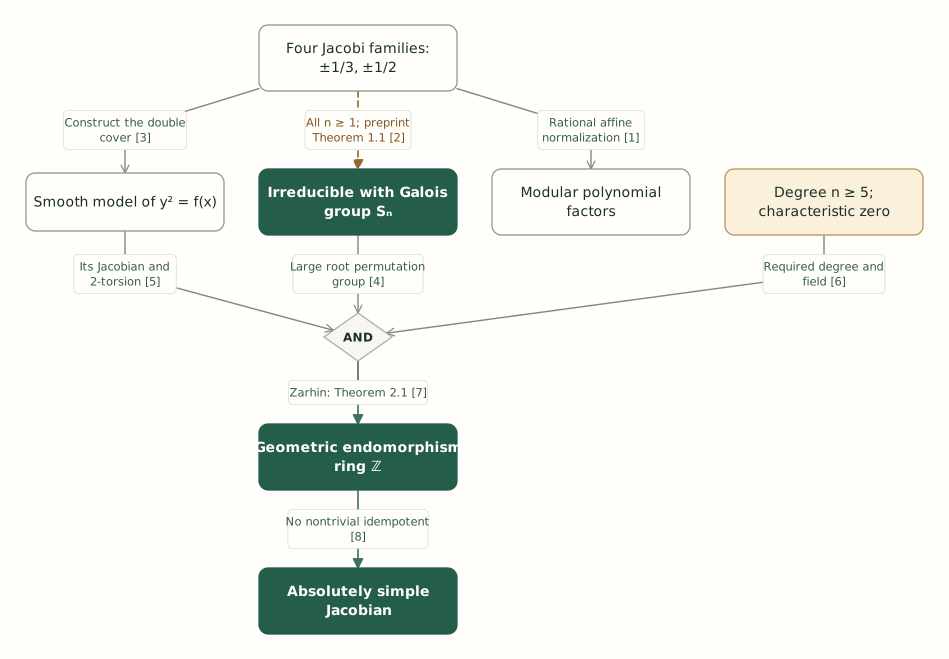
→ deduction or information flow preprint claimAND joint hypotheses
Let , with and . Theorem 1.1 of the 2026 Jacobi preprint claims that every such polynomial is irreducible over and has group .
The published modular identification is exact. Put . The corresponding Kaneko–Zagier factor is
This rational affine substitution preserves the splitting field. If is prime, the monic supersingular -polynomial satisfies
The two exponents record whether the supersingular invariants and occur. The prime-index requirement belongs to this modular reduction, not to the characteristic-zero Galois claim.
Now suppose , and let be the smooth projective model of . Its genus is . Combining the claimed group with Zarhin’s published theorem gives
Thus the Jacobian is absolutely simple. This application retains the preprint dependency even though Zarhin’s implication is established. Irreducibility by itself would not provide its group hypothesis.
Inspect all 8 connections and exact references
| Connection | Statement and source |
|---|---|
| 1Four Jacobi families: ±1/3, ±1/2 → Modular polynomial factorsConstruction / input | The four Jacobi polynomials become Kaneko–Zagier modular factors under the stated rational affine substitution and scaling.
|
| 2Four Jacobi families: ±1/3, ±1/2 → Irreducible with Galois group SₙDeduction · preprint | The preprint claims irreducibility and the full symmetric group for each of the four families in every positive degree.
|
| 3Four Jacobi families: ±1/3, ±1/2 → Smooth model of y² = f(x)Construction / input | The distinct roots of f are the finite branch points of the smooth projective model of y²=f(x).
|
| 4Irreducible with Galois group Sₙ → ANDConstruction / input | The symmetric-group input is the preprint-dependent hypothesis for this application. |
| 5Smooth model of y² = f(x) → ANDConstruction / input | Zarhin’s argument uses the root permutation action on the Jacobian’s 2-torsion. |
| 6Degree n ≥ 5; characteristic zero → ANDConstruction / input | The application is over Q and is restricted to n≥5. |
| 7AND → Geometric endomorphism ring ℤDeduction | For a characteristic-zero polynomial of degree at least five with group Sₙ or Aₙ, Zarhin proves that every geometric Jacobian endomorphism is integer multiplication.
|
| 8Geometric endomorphism ring ℤ → Absolutely simple JacobianDeduction | A nontrivial abelian subvariety would give an idempotent in the rational endomorphism algebra, whereas End⁰=Q has only 0 and 1.
|
Sources and scope checked .
Questions
Are all four Kaneko–Zagier families irreducible with symmetric Galois group?
Scope. Integers , , , over .
Define the shifted Jacobi polynomial
The conjecture asks whether every in these four families is irreducible with Galois group . These are the Jacobi normalizations of the Kaneko–Zagier families after their forced elliptic factors are removed. The 2026 preprint claims the full result; it is not used here as an established theorem.
References 3
- MahlburgOno2004 · Conjecture on p. 40Source
- CullinanHajir2017 · Conjecture 1.4Source
- NguyenDang2026Jacobi · Abstract; version 1Source
Related topics
Hermite, Bessel, and Legendre polynomials
The Legendre group problem uses related Jacobi coefficient products.
UsesNewton polygons and Galois groups
Prime divisors produce long cycles in the Galois action.
Linked from 2 articles
References
- Algebraic properties of Kaneko-Zagier lifts of supersingular polynomials
Cullinan, John and Hajir, Farshid. Proceedings of the American Mathematical Society, 145(6), 2291–2304, 2017.
Read the source - Arithmetic of certain hypergeometric modular forms
Mahlburg, Karl and Ono, Ken. Acta Arithmetica, 113(1), 39–55, 2004.
Read the source - On the Newton polygons of Kaneko–Zagier lifts of supersingular polynomials
Cullinan, John and Gajek-Leonard, Rylan. Research in Number Theory, 2, Article 34, 2016.
Read the source - Arithmetic of Jacobi polynomials
Nguyen-Dang, Khai-Hoan. Hexagon preprint, 2026.
Read the source - Supersingular j-invariants, hypergeometric series, and Atkin’s orthogonal polynomials
Kaneko, Masanobu and Zagier, Don. AMS/IP Studies in Advanced Mathematics, 7, 97–126, 1998.
Read the source - Hyperelliptic Jacobians without complex multiplication
Zarhin, Yuri G. Mathematical Research Letters, 7(1), 123–132, 2000.
Read the source
Comments
Any comments are welcome. Comments appear after the site owner approves them. Privacy policy.