Overview
- Is irreducible for every and ?
- If it is irreducible, must its group contain ?
- Which coefficient modifications preserve irreducibility?
Definition
For integers and , set
The parameter of the Laguerre polynomial varies with its degree. The case is the exponential truncation. The diagonal is equivalent to the Bessel polynomial by reversal and rational scaling.
Known ranges
Hajir proves both conjectures for each fixed and sufficiently large , and in every degree for . Jindal–Nair–Shorey extend all-degree irreducibility to . For , they exclude proper linear factors and obtain alternating-group containment conditional on irreducibility. Their result does not eliminate higher-degree factors in that last range.
References 2
- Hajir2009 · Theorems 1.3–1.4Source
- JindalNairShorey2024 · Abstract; the paper writes s for rSource
Connections and evidence
PublishedNegative Laguerre parameters: a complete Galois classification
Factor exclusion, local permutations, and the discriminant determine every group in the strip .
Scope. Over , for every integer and every integer , with .
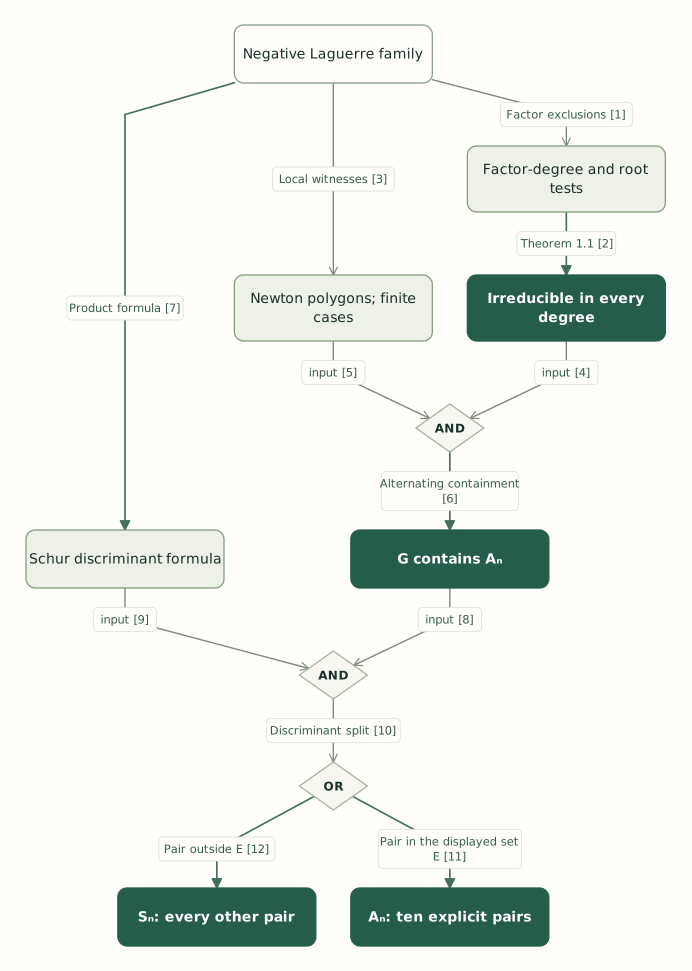
→ deduction or information flowAND joint hypothesesOR alternatives
Let , with integers and . Jindal–Nair–Shorey prove that every member is irreducible over , and give the complete group classification
where
The factor-degree restrictions leave only a possible linear factor; the root analysis excludes it. Newton-index arguments and finite checks then give alternating containment. For the monic normalization, Schur’s formula is
For , its square class selects the two branches. Degree one is immediate, with . The adjacent range requires irreducibility separately; see known ranges.
Inspect all 12 connections and exact references
| Connection | Statement and source |
|---|---|
| 1Negative Laguerre family → Factor-degree and root testsConstruction / input | The recalled factor-degree theorem and the rational-root analysis exhaust possible proper factors in this parameter strip.
|
| 2Factor-degree and root tests → Irreducible in every degreeDeduction | Eliminating the possible linear factor completes irreducibility; degrees one and two are included in the stated theorem.
|
| 3Negative Laguerre family → Newton polygons; finite casesConstruction / input | The proof obtains alternating containment from Newton-index witnesses, with the remaining finite degrees handled separately.
|
| 4Irreducible in every degree → ANDConstruction / input | Transitivity is one input to the permutation-group argument. |
| 5Newton polygons; finite cases → ANDConstruction / input | The local witnesses and finite checks are the other input; irreducibility alone does not determine the group. |
| 6AND → G contains AₙDeduction | The joint inputs establish alternating containment for every degree in the selected parameter strip.
|
| 7Negative Laguerre family → Schur discriminant formulaDeduction | Schur’s formula computes the discriminant of the monic normalization.
|
| 8G contains Aₙ → ANDConstruction / input | For n ≥ 2, alternating containment leaves Aₙ and Sₙ as the two possibilities; in degree one they coincide. |
| 9Schur discriminant formula → ANDConstruction / input | For n ≥ 2, the discriminant square class distinguishes Aₙ from Sₙ; degree one is handled directly. |
| 10AND → ORConstruction / input | For n ≥ 2, the explicit square-discriminant calculation gives the exceptional pairs; n = 1 belongs to the trivial S₁ branch.
|
| 11OR → Aₙ: ten explicit pairsDeduction | For a pair in E, the group is exactly Aₙ.
|
| 12OR → Sₙ: every other pairDeduction | For every other pair in the stated strip, the group is exactly Sₙ.
|
Sources and scope checked .
An explicit degree bound
Jindal–Laishram–Sarma prove both conjectures for . They also give the sufficient bound
The cases are already known in every degree. Their method combines restrictions on factor degrees with Newton polygons and estimates for primes. The bound is effective and grows exponentially with .
References 1
- JindalLaishramSarma2018 · Theorems 1.1–1.2 and §6The logarithmic bound is written only for r≥2; its printed formula is undefined at r=0,1.Source
Padé approximants
The same family occurs in rational approximation to the exponential function. For positive integers ,
Thus arithmetic questions about the numerator and denominator are Laguerre questions. Cullinan–Scheel use this identity to study their irreducibility and Galois groups. When , reversal identifies the polynomials with the Bessel family, so both have group . Their near-diagonal group theorem assumes irreducibility; that hypothesis is explicit in the source.
References 3
- CullinanScheel2022 · Equations (1.0.1)–(1.0.6), Theorems 1.0.8–1.0.9 (arXiv version)The source uses monic polynomials u!F_(u,v) and v!F_(v,u)(−x); the displayed ratio removes the scalar mismatch.Source
- FilasetaTrifonov2002 · Main theoremSource
- Grosswald1978Source
Recent preprint
The November 2026 preprint uses , with . It claims a degree threshold independent of , together with an effective finite exceptional set. The remaining finite exceptional set is not resolved by this claim alone. Its full argument has not been verified here.
References 1
- NguyenDang2026UniformLaguerre · Equation (1.4), Theorem 1.1 and Corollary 1.2; version 1, 4 November 2026Source
Coefficient modifications
If , an admissible modification is , with , , and . Irreducibility of every such modification is stronger and sometimes false: for , changing the sign of the constant coefficient of gives
Banerjee–Bera prove eventual irreducibility of all admissible modifications for each fixed r. Shorey–Sinha give further small-parameter factor restrictions and explicit exceptional-pair calculations.
References 4
- Hajir2009 · §8, Question 8.1 and the example following itSource
- BanerjeeBera2020Modifications · AbstractSource
- ShoreySinha2022 · AbstractSource
- ShoreySinha2022II · AbstractSource
Questions
Is irreducible for every and ?
Scope. Integers and , over .
Set
Hajir’s first conjecture asks whether this polynomial is irreducible for every such pair. The published ranges and the recent uniform preprint claim do not by themselves settle every pair.
References 3
- Hajir2009 · Conjecture 1.1Source
- JindalNairShorey2024 · AbstractSource
- NguyenDang2026UniformLaguerre · AbstractSource
If is irreducible, must its group contain ?
Scope. , , assuming irreducibility over .
This is Hajir’s second conjecture. Equality with is not asserted: the discriminant can be a square.
Which Laguerre polynomials remain irreducible under every admissible coefficient modification?
Scope. Integers , ; all with and ; irreducibility over .
Classify the pairs for which every polynomial
with the stated endpoint conditions is irreducible. This is the admissible modification problem for Hajir’s family. The pair is excluded: taking and gives . Later work proves eventual results for each fixed and further explicit small-parameter results; the full classification remains open.
References 3
- Hajir2009 · Question 8.1Source
- BanerjeeBera2020Modifications · AbstractSource
- ShoreySinha2022II · AbstractSource
Related topics
Connected diagrams
Browse all diagrams →Generalized Laguerre polynomials
The Laguerre parameter here depends on both integer indices.
IncludesTaylor polynomials
The line r=0 consists of exponential truncations.
IncludesHermite, Bessel, and Legendre polynomials
The line r=n is a reversal of the Bessel family.
Linked from 1 articles
References
- Algebraic properties of a family of generalized Laguerre polynomials
Hajir, Farshid. Canadian Journal of Mathematics, 61(3), 583–603, 2009.
Read the source - Extension of irreducibility results on generalized Laguerre polynomials L_n^(-n-s-1)(x)
Jindal, Ankita and Nair, Saranya G. and Shorey, Tarlok N. Publicationes Mathematicae Debrecen, 105(3-4), 473–494, 2024.
Read the source - Irreducibility and Galois groups of generalized Laguerre polynomials L_n^(-1-n-r)(x)
Jindal, Ankita and Laishram, Shanta and Sarma, Ritumoni. Journal of Number Theory, 183, 388–406, 2018.
Read the source - On the arithmetic of Padé approximants to the exponential function
Cullinan, John and Scheel, Nick. Journal of the Ramanujan Mathematical Society, 37(3), 207–219, 2022.
Read the source - The irreducibility of the Bessel polynomials
Filaseta, Michael and Trifonov, Ognian. Journal für die reine und angewandte Mathematik, 550, 125–140, 2002.
Read the source - Bessel Polynomials
Grosswald, Emil. Springer, Lecture Notes in Mathematics, vol. 698, 1978.
Read the source - Uniform irreducibility and Galois groups of generalized Laguerre polynomials
Nguyen-Dang, Khai-Hoan. Hexagon preprint, 2026.
Read the source - An irreducibility question concerning modifications of Laguerre polynomials
Banerjee, Pradipto and Bera, Ranjan. International Journal of Number Theory, 16(5), 1031–1051, 2020.
Read the source - Extension of Laguerre polynomials with negative arguments
Shorey, Tarlok N. and Sinha, Sneh Bala. Indagationes Mathematicae, 33(4), 801–815, 2022.
Read the source - Extension of Laguerre polynomials with negative arguments II
Shorey, Tarlok N. and Sinha, Sneh Bala. Indagationes Mathematicae, 33(4), 880–884, 2022.
Read the source
Comments
Any comments are welcome. Comments appear after the site owner approves them. Privacy policy.