Overview
- Which entry laws give unconditional irreducibility?
- How do matrix ranks determine root counts modulo primes?
- What does irreducibility imply about rational invariant subspaces?
The independent-entry model
Let have independent entries of common law , a fixed finitely supported nonconstant law on , and set . As the dimension grows, one asks whether is irreducible with probability tending to one and whether its Galois group is with probability tending to one.
Example
For ,
If are signs and , the determinant is or . If , it is or . For independent fair signs, the conditional laws of the determinant differ, so the trace and determinant are dependent.
The dependence prevents a direct application of the independent-coefficient theorems to . Symmetric, tridiagonal, and fixed-size height-bounded matrices are separate ensembles.
Eberhard’s theorems
Theorem · Eberhard
In the independent-entry model above:
- If is uniform modulo a product of four distinct primes, irreducibility and hold with probability tending to one, unconditionally.
- For any fixed finitely supported nonconstant law , assume the Riemann hypothesis for Dedekind zeta functions of all number fields. Then and , with constants depending on .
The uniform law on satisfies the first hypothesis, since . The fair-sign law fails this hypothesis. Both theorems leave the alternatives and .
References 1
- Eberhard2022 · Theorems 1.2 and 1.3Unconditional four-prime theorem and conditional general theorem.Source
Finite-field eigenvalues and Galois orbits
The equality holds exactly when is singular. Root counts modulo a prime therefore depend on the rank of a random matrix over . Counting tuples of roots requires joint singularity estimates for distinct values of .
For a squarefree polynomial with root set , the orbit-counting lemma identifies the number of -orbits on with the average number of fixed roots of elements of . At good primes, the number of roots modulo the prime equals the number fixed by Frobenius. Effective prime-ideal estimates relate these local counts to the Galois average. Higher root correlations correspond to actions on tuples.
References 2
- Eberhard2022 · §1.1 and §3Local root statistics and the effective global-to-local step.Source
- StevenhagenLenstra1996Frobenius and density as the general framework.Source
Other matrix ensembles
In the first three rows, the dimension tends to infinity and the entry law is fixed. “Dedekind RH” concerns zeta functions of number fields, not only the Riemann zeta function.
| Ensemble and independent data | Arithmetic hypothesis | Conclusion and failure bound |
|---|---|---|
| Full matrix: all entries independent with a fixed finitely supported nonconstant integer law . | RH for Dedekind zeta functions of all number fields is a sufficient hypothesis. | ; . Constants depend on . Eberhard, Theorem 1.3. |
| Symmetric sign matrix: entries on and above the diagonal are independent fair signs; entries below are determined by symmetry. | RH for Dedekind zeta functions of all number fields. | Irreducibility failure at most , with absolute . Ferber–Jain–Sah–Sawhney, Theorem 1.1. This theorem does not assert containment of . |
| Symmetric tridiagonal matrix: diagonal entries are independent with a fixed bounded nonconstant integer law; adjacent off-diagonal entries equal 1. | RH for the root fields of every integer-diagonal matrix of this form, as in equations (2)–(3) of the source. RH for all number fields suffices. | Irreducible with group or , except with probability . Bary-Soroker–Garzoni–Sodin, Theorem 1. |
| Fixed-size matrix: entries range over an integer box of height H. | No analytic hypothesis; dimension is fixed and . | Exceptional-group counts belong to a height-counting model. Anderson–O’Dorney. |
The tridiagonal theorem also allows unbounded laws satisfying for some , all . Its constants depend only on these tail constants and the second-largest atom. A separate constant-diagonal ensemble in the same paper has additional symmetry and a smaller possible group.
References 4
- Eberhard2022 · Theorem 1.3 and footnotes 2–3Source
- FerberJainSahSawhney2023 · Theorem 1.1; model preceding it, arXiv:2106.04049v1Independence is on and above the diagonal; the displayed conclusion is irreducibility.Source
- BarySorokerGarzoniSodin2026 · Theorem 1 and equations (1)–(4), arXiv:2502.17218v3The stated root-field hypothesis is weaker than Dedekind RH for all number fields.Source
- AndersonODorney2026Matrices · Fixed-size height-counting modelSource
Connections and evidence
ConditionalTridiagonal matrices, Galois groups, and spectral uncertainty
Finite-field mixing and Dedekind RH yield an alternating or symmetric Galois group with exponentially high probability. Emmrich’s theorem then turns that arithmetic event into a simultaneous uncertainty inequality for every nonzero vector.
Scope. ; is real symmetric tridiagonal with adjacent entries one and iid nonconstant integer diagonal entries , satisfying for some , all . The root-field Dedekind RH hypothesis stated below is retained.
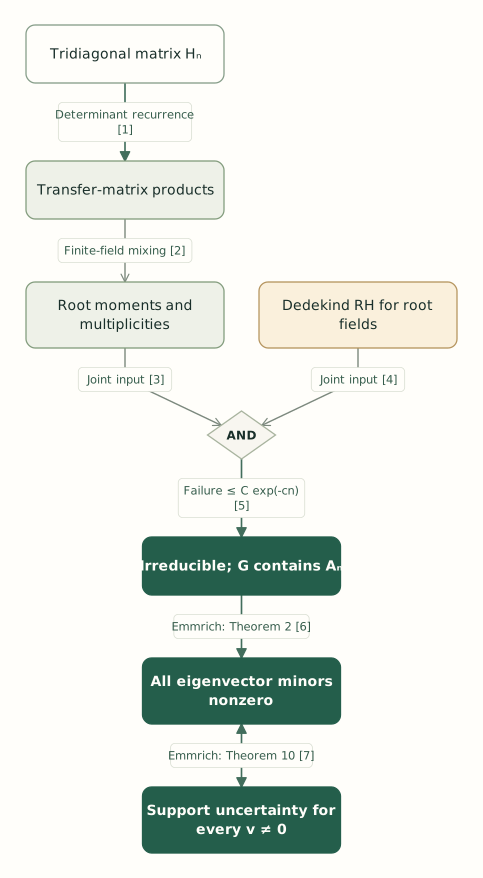
→ deduction or information flow↔ equivalenceAND joint hypotheses
Put , , and all other entries zero. The diagonal law is fixed, nonconstant and integer-valued, with the logarithmic tail bound in the scope. Every bounded nonconstant integer law qualifies. Write .
Published theorem, conditional on Dedekind RH. Assume RH for each Dedekind zeta function of , where is a root of the characteristic polynomial of any integer-diagonal matrix of this tridiagonal form. RH for all number fields is sufficient. Bary-Soroker–Garzoni–Sodin prove that there are constants , depending on the law, such that
The transfer identity is
Higher root-count moments, rather than just the expected number of roots, detect the required permutation-group action.
Let have real orthonormal eigenvectors of as columns. On the same event, Emmrich’s theorems give nonvanishing of every minor and, simultaneously for all ,
The support is the set of nonzero coordinates. Thus a vector cannot be sparse in both the coordinate and eigenvector bases. No additional union bound over vectors is needed. The authors already record this consequence in §1.2; the hypothesis remains attached to the probability estimate.
Inspect all 7 connections and exact references
| Connection | Statement and source |
|---|---|
| 1Tridiagonal matrix Hₙ → Transfer-matrix productsDeduction | The characteristic polynomial is the upper-left entry of the ordered product of the transfer matrices T(X-V_j).
|
| 2Transfer-matrix products → Root moments and multiplicitiesConstruction / input | The transfer-matrix random walk supplies prime-averaged higher root-count moments, together with control of proper powers.
|
| 3Root moments and multiplicities → ANDConstruction / input | The quantitative root-count and multiplicity estimates enter the arithmetic argument. |
| 4Dedekind RH for root fields → ANDConstruction / input | Dedekind RH supplies the effective prime-ideal estimates needed at the chosen prime range. |
| 5AND → Irreducible; G contains AₙDeduction | Theorem 1 gives irreducibility and alternating-group containment on one event of probability at least 1-C exp(-cn).
|
| 6Irreducible; G contains Aₙ → All eigenvector minors nonzeroDeduction | For this diagonalizable rational matrix, alternating-group containment forces every minor of an eigenvector matrix to be nonzero.
|
| 7All eigenvector minors nonzero ↔ Support uncertainty for every v ≠ 0Equivalence | For a real orthogonal eigenvector matrix U, nonvanishing of every minor is equivalent to the support inequality for every nonzero complex vector.
|
Sources and scope checked .
Rational invariant subspaces
An irreducible characteristic polynomial excludes nonzero proper rational invariant subspaces.
Proof
If is -invariant and , a basis adapted to puts in block upper-triangular form. Then is the product of the characteristic polynomials on and , both of positive degree.
Nonsingularity and distinct eigenvalues are insufficient: has both properties and preserves two rational lines.
Questions
Does irreducibility hold unconditionally for every fixed entry law?
Scope. Independent entries of any fixed nonconstant finitely supported law on Z, with n tending to infinity.
Eberhard’s Conjecture 1.1 concerns irreducibility for arbitrary fixed entry laws. His general theorem assumes ERH, and the unconditional theorem requires uniformity modulo four distinct primes. In particular, the latter theorem does not cover fair signs. Full is a further question.
References 1
- Eberhard2022 · Conjecture 1.1; Theorems 1.2–1.3Exact conjectural and proved scopes.Source
Are reducible characteristic polynomials the main exception for matrices of bounded height?
Scope. Fixed matrix size n≥2; integer entries of absolute value at most T; T→∞.
Let count matrices whose characteristic polynomial has group different from , and those with reducible characteristic polynomial. Anderson–O’Dorney conjecture
The lower bound comes from integer eigenvalues. Their general upper bound is . The size is fixed here; this is a different problem from bounded entries and growing dimension.
References 2
- AndersonODorney2026Matrices · Conjecture 1.2; Theorems 1.3 and 2.1The reducible-count prediction is attributed there to Rivin, Conjecture 12.Source
- Rivin2008 · Conjecture 12Source
Related topics
Random polynomials: models and methods
Independent matrix entries give dependent characteristic coefficients.
UsesFrobenius and factorization modulo primes
Root counts modulo primes give fixed-point statistics for Frobenius.
Contrasts withHeight bounds for exceptional Galois groups
The entry height grows at fixed matrix size.
UsesDiscriminants, parity, and ramification
The discriminant square class distinguishes A_n from S_n after containment.
References
- The characteristic polynomial of a random matrix
Eberhard, Sean. Combinatorica, 42(4), 491–527, 2022.
Read the source - Chebotarëv and his density theorem
Stevenhagen, Peter and Lenstra, Jr., Hendrik W. The Mathematical Intelligencer, 18(2), 26–37, 1996.
Read the source - Random symmetric matrices: rank distribution and irreducibility of the characteristic polynomial
Ferber, Asaf and Jain, Vishesh and Sah, Ashwin and Sawhney, Mehtaab. Mathematical Proceedings of the Cambridge Philosophical Society, 174(2), 233–246, 2023.
Read the source - Irreducibility of the characteristic polynomials of random tridiagonal matrices
Bary-Soroker, Lior and Garzoni, Daniele and Sodin, Sasha. Journal of Number Theory, 280, 973–998, 2026.
Read the source - Galois groups of random integer matrices
Anderson, Theresa C. and O’Dorney, Evan M. Mathematical Proceedings of the Cambridge Philosophical Society, 1–16, 2026.
Read the source - Walks on groups, counting reducible matrices, polynomials, and surface and free group automorphisms
Rivin, Igor. Duke Mathematical Journal, 142(2), 353–379, 2008.
Read the source - Nonvanishing minors of eigenvector matrices and consequences
Emmrich, Tarek. Special Matrices, 12(1), Article 20240020, 2024.
Read the source
Comments
Any comments are welcome. Comments appear after the site owner approves them. Privacy policy.