Overview
- Why do iterated Galois groups lie in wreath products?
- How are stability and maximality different?
- How do square classes determine quadratic groups?
- When can a finite level determine the infinite group?
The preimage tree
Let have degree , and fix . Suppose has distinct roots for every . Make these roots the vertices at level , keep separate copies at different levels, and join to . Level zero consists of . Each vertex has children.
If is the splitting field of , then . Every element of preserves the tree because . Passing to all levels gives the arboreal representation
In characteristic zero, the separability assumption is equivalent to saying that is not a positive iterate of any critical point of .
References 2
- Odoni1985 · Galois theory of iteratesSource
- Jones2013Arboreal · §1.1Source
The largest possible tree group
A tree automorphism may permute the branches at the root and act independently on each branch. Consequently,
This is the iterated wreath product of . For , the tree group is a proper subgroup of . For example, a quadratic second iterate has a group inside the order-eight group .
Transitivity of is equivalent to irreducibility of . Surjectivity of means equality with the full tree group at every level. Finite index permits some failure of maximality but bounds the indices independently of .
References 1
- Jones2013Arboreal · §1.1; tree automorphisms and finite indexSource
Stability and the size of the image
Let be the closed arboreal image in , with the regular, separable preimage tree defined above. The pair is stable if every is irreducible over , and eventually stable if the number of irreducible factors is bounded independently of . Then
If , then has at most orbits on each level: if and is any vertex on the level, then its vertices lie in the orbits . These orbits are the irreducible factors of the corresponding preimage polynomial.
| Polynomial and base field; target | Factorization of iterates | Arboreal image |
|---|---|---|
| over | Every iterate is irreducible. | Full image, by Stoll. |
| over | Every iterate is irreducible. | Infinite index; the level- group is . |
| over | Exactly two irreducible factors at every positive level. | Index two. |
The cyclotomic calculation for is given below. For the last row, the first splitting field over is . Base change therefore replaces the full binary tree group by the kernel of its action on level one. This subgroup has index two and acts transitively on each of the two branches. Thus finite index need not imply stability, and stability need not imply finite index.
References 3
- Jones2013Arboreal · §1.1, tree actions and factorizationSource
- Stoll1992 · Theorem in §1Surjectivity for x²+1; the base-change example follows directly.Source
- Kadets2020LargeArboreal · Example 1.1Source
A quadratic maximality criterion
Theorem
Let have characteristic different from two, let , and set
Fix and suppose . Then the splitting field of has group if and only if are linearly independent in . Thus no nonempty product of the may be a square in .
Proof
For , let be the sign of the permutation on level . The decomposition gives : in the abelianization, the top swap identifies the two branch copies of . A swap at one vertex of level has negative sign on level and positive sign at every other level. Hence the form a basis of the quadratic characters of .
Every proper subgroup of the finite 2-group lies in a subgroup of index two. Therefore is all of exactly when no nontrivial product of the is trivial on .
Put . The derivative and resultant formulas give
Indeed, . The discriminant classes are consequently for , and for . The discriminants are nonzero by hypothesis, so all these polynomials are separable.
The action on a square root of a discriminant is the sign character on the roots. Kummer theory identifies products of these characters with products of the corresponding square classes. The preceding subgroup criterion now gives the equivalence.
References 3
- Stoll1992 · Theorem in §1, equivalence of (a) and (b)The rational-parameter criterion.Source
- Kadets2020LargeArboreal · §2, Proposition 2.5 and Corollary 2.6Discriminant characters and maximal tree actions; the quadratic proof is given here.Source
- Stoll2026Arboreal · Proposition 1.7; arXiv:2611.14014v1Source
Example
For , the first three adjusted critical values are . A product containing is negative; the remaining nonempty products are nonsquares. Hence the Galois group through level three is the full binary tree group, of order . Stoll’s theorem proves maximality at every level for this polynomial.
A useful sufficient condition for independence is the following: for each , find a prime such that is odd and is even for every . In a nonempty product, the prime belonging to the largest index then has odd valuation. This explains why new prime divisors of critical values often prove maximality.
An even-degree criterion
Kadets extends the square-class approach to even degree. Assume , is even, the target is not periodic, and all preimage equations are separable. Suppose that, for every and every , the polynomial has Galois group over . If
are independent in , then the arboreal representation is surjective. Both assumptions matter: the square classes control how the extensions fit together, while the fiber groups supply the full symmetric action at each vertex.
References 1
- Kadets2020LargeArboreal · Theorem 1.2 and §2Source
A stable polynomial with cyclic groups
Let . The identity
gives an exact description of the roots of every iterate. If is a primitive -th root of unity, then is a root of and has degree . Thus is irreducible over .
All its roots lie in , so this is also its splitting field. Therefore
The group is transitive at every level but has infinite index in the full binary tree group. The critical orbit is finite.
References 1
- BenedettoGhiocaJuulTucker2026Preperiodic · §1.4, Chebyshev polynomialsThe cyclotomic calculation is given here.Source
Generic groups and arithmetic examples
For a generic monic polynomial over a characteristic-zero coefficient field, Odoni proves that every iterate has the full -fold wreath product. Juul extends the generic theorem to positive characteristic, with the exception .
A fixed finite level can be studied by Hilbert irreducibility. Obtaining one specialization that works at every level requires further arithmetic: infinitely many separate applications of Hilbert irreducibility do not by themselves produce a common specialization. Looper, Benedetto–Juul, and Specter construct arithmetic examples using local conditions that persist through the tower.
References 5
- Odoni1985 · Generic polynomial theoremSource
- Juul2019 · Theorem 1.1Source
- Looper2019 · Theorem 1.1Source
- BenedettoJuul2019 · Theorem 1.1 in the author manuscript; Theorem 1.2 in arXiv:1803.01987v1Source
- Specter2018 · Theorem 1.2; arXiv:1803.00434v2, preprintSource
Recent work
For targets outside the forward critical orbit, the periodic and strictly preperiodic postcritically finite quadratic cases are treated by Benedetto–Ghioca–Juul–Tucker in papers published in 2025 and 2026. Their groups record the critical-orbit relations; maximality in those descriptions is relative to the specified constrained group.
A March 2026 preprint by Henderson–Juul–Lattin–Mercado–Schaefer gives new surjective representations for quadratic polynomials with specified strictly preperiodic targets. For example, their Theorem 2 applies to
since is a nonsquare and the denominator satisfies the stated condition. Here . The claimed surjectivity concerns the polynomials , with this target.
References 3
- BenedettoGhiocaJuulTucker2025Periodic · Theorem 1.5Source
- BenedettoGhiocaJuulTucker2026Preperiodic · Theorems 1.2 and 7.6; §1.4 for the exceptional Chebyshev caseSource
- HendersonJuulLattinMercadoSchaefer2026 · Theorem 2(1) and Example 3; arXiv:2603.25899v1, preprintSource
Finite-level detection
For , , Stoll’s November 2026 preprint proves that maximality at level two implies maximality at all levels in explicitly specified regions and congruence classes of . It also records the general conjecture that level four suffices.
The fourth level cannot be replaced by the third. For ,
The first three classes are independent: the sign detects the first, the prime detects the second, and the prime detects the third. But
Thus the first three groups are maximal and the fourth is not.
References 2
- Stoll2026Arboreal · Theorem 6.1, Conjecture 8.1 and Remark 8.5; arXiv:2611.14014v1Source
- Hindes2015IterationCurves · §3, Remark 3.4 and final discussion, p. 26Source
Connections and evidence
Claimed · preprintFrom critical square classes to every quadratic iterate
At each finite level, square-class independence is equivalent to the full binary-tree Galois group. A 2026 preprint extends a two-level check to every level under explicit parameter conditions.
Scope. over , target zero, . The finite-to-infinite step here is the positive subfamily , with coprime positive integers, even and .
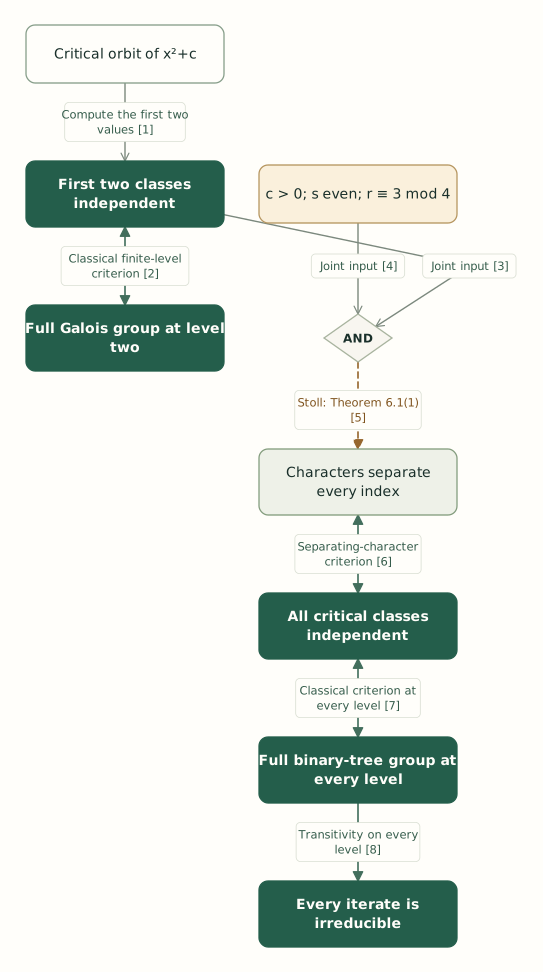
→ deduction or information flow↔ equivalence preprint claimAND joint hypotheses
For , set and for . The sign change at the first term is essential. If , all these values are nonzero and the preimages of zero form a regular binary tree. Write .
Classical criterion. For every ,
Independence means that no nonempty product is a square.
Restricted preprint criterion, Stoll v1. Let in lowest terms, with , even and . Theorem 6.1(1), using Lemma 4.3(C3), implies that independence of and gives for every . The initial check is automatic: and , while is positive and nonsquare. Indeed, supplies a prime with odd , and coprimality gives .
For , the initial classes are and . Neither these nor their product is a square. The conclusion is
The proof constructs characters distinguishing each critical value from all later values. The congruence conditions are part of the finite-to-infinite step; level-two maximality alone is insufficient for arbitrary rational parameters.
Why this parameter family works
Following Stoll’s character argument, write
The recurrence gives . For the prime above, is on every . The sign character is on and on all later terms.
For , put . Positivity and the congruences give and . Hence a prime divides . The recurrence and coprimalities imply , so
The quadratic residue character of the -adic unit part therefore takes opposite signs on and its entire tail. Either this character or its product with sends to and all later terms to . Such a character at every index excludes a square product by its least index. The classical criterion then gives the stated groups at every level. This is a proof sketch of the selected subfamily; the all-level result remains labelled as a preprint claim.
Inspect all 8 connections and exact references
| Connection | Statement and source |
|---|---|
| 1Critical orbit of x²+c → First two classes independentConstruction / input | Compute b₁=-c and b₂=c²+c and test that neither class nor their product is a square. |
| 2First two classes independent ↔ Full Galois group at level twoEquivalence | The first two adjusted critical classes are independent exactly when the second-level Galois group is the full order-eight binary-tree group.
|
| 3First two classes independent → ANDConstruction / input | The initial independence check is combined with the stated parameter conditions. |
| 4c > 0; s even; r ≡ 3 mod 4 → ANDConstruction / input | The congruences are imposed on the coprime positive numerator r and denominator s. |
| 5AND → Characters separate every indexDeduction · preprint | For the stated positive parameter subfamily, the initial conditions and the congruences produce quadratic characters separating every adjusted critical value from all later values.
|
| 6Characters separate every index ↔ All critical classes independentEquivalence | Characters taking value -1 at one index and +1 at all later indices exist for every index exactly when the critical square classes are independent.
|
| 7All critical classes independent ↔ Full binary-tree group at every levelEquivalence | Independence of the infinite family means independence of every finite prefix, hence maximality at every finite level.
|
| 8Full binary-tree group at every level → Every iterate is irreducibleDeduction | The full binary-tree group acts transitively on the roots of each iterate, so each iterate is irreducible over Q.
|
Sources and scope checked .
Primes in polynomial orbits
These groups also help study a recurrence with . If a prime divides some nonzero , then, apart from finitely many early terms, a reduction of has a root modulo that prime. At unramified primes, Frobenius must therefore fix a root of .
Chebotarev turns the proportion of such group elements into a density bound for primes. If the proportion with a fixed point tends to zero as , then the primes dividing the orbit have density zero. Jones applies this method to several infinite families of integral quadratic polynomials.
References 1
- Jones2008PrimeDivisors · Theorems 1.1–1.2 and Galois/probability methodSource
Related topics
Composition and iteration
Overview and open questions.
RelatedIrreducibility of iterates
Irreducibility and factor counts.
RelatedPolynomial decomposition
Composition gives the blocks of the tree.
RelatedGleason and Misiurewicz polynomials
Critical-orbit relations in parameter space.
RelatedFrobenius and factorization modulo primes
Fixed points of Frobenius and prime divisors of orbits.
RelatedSpecialization and Hilbert irreducibility
Generic groups and specializations.
References
- The Galois Theory of Iterates and Composites of Polynomials
Odoni, R. W. K. Proceedings of the London Mathematical Society (3), 51(3), 385–414, 1985.
Read the source - Galois representations from pre-image trees: an arboreal survey
Jones, Rafe. Publications mathématiques de Besançon. Algèbre et théorie des nombres, 107–136, 2013.
Read the source - Galois groups over Q of some iterated polynomials
Stoll, Michael. Archiv der Mathematik, 59, 239–244, 1992.
Read the source - Large arboreal Galois representations
Kadets, Borys. Journal of Number Theory, 210, 416–430, 2020.
Read the source - When do all iterates of x²+a have maximal Galois group?
Stoll, Michael. arXiv preprint, 2026.
Read the source - Arboreal Galois groups of postcritically finite quadratic polynomials: The strictly preperiodic case
Benedetto, Robert L. and Ghioca, Dragos and Juul, Jamie and Tucker, Thomas J. Canadian Journal of Mathematics, 2026.
Read the source - Iterates of Generic Polynomials and Generic Rational Functions
Juul, Jamie. Transactions of the American Mathematical Society, 371(2), 809–831, 2019.
Read the source - Dynamical Galois groups of trinomials and Odoni's conjecture
Looper, Nicole R. Bulletin of the London Mathematical Society, 51(2), 278–292, 2019.
Read the source - Odoni's conjecture for number fields
Benedetto, Robert L. and Juul, Jamie. Bulletin of the London Mathematical Society, 51(2), 237–250, 2019.
Read the source - Polynomials with Surjective Arboreal Galois Representations Exist in Every Degree
Specter, Joel. arXiv preprint, 2018.
Read the source - Arboreal Galois groups of postcritically finite quadratic polynomials: The periodic case
Benedetto, Robert L. and Ghioca, Dragos and Juul, Jamie and Tucker, Thomas J. Journal of the London Mathematical Society, 112(2), e70257, 2025.
Read the source - Examples of Quadratic Polynomials over Q with Surjective Arboreal Galois Representations
Henderson, Luck and Juul, Jamie and Lattin, Brenner and Mercado, Enrique and Schaefer, Mia. arXiv preprint, 2026.
Read the source - The arithmetic of curves defined by iteration
Hindes, Wade. Acta Arithmetica, 169(1), 1–27, 2015.
Read the source - The density of prime divisors in the arithmetic dynamics of quadratic polynomials
Jones, Rafe. Journal of the London Mathematical Society, 78(2), 523–544, 2008.
Read the source
Comments
Any comments are welcome. Comments appear after the site owner approves them. Privacy policy.