Overview
- How does composition differ from multiplication?
- How do intermediate fields give decompositions?
- When is the monodromy group primitive?
- How can two complete decompositions differ?
Composition factors
A polynomial of degree greater than one is indecomposable over if it cannot be written as with and . A complete decomposition writes with every indecomposable.
Linear polynomials are the invertible elements for composition. Thus for every , . Such changes give equivalent decompositions. Unlike multiplication, composition is usually not commutative, and distinct complete decompositions need not differ only by linear changes.
Intermediate fields
Let be algebraically closed of characteristic zero and let be transcendental over . A decomposition gives
Conversely, Lüroth’s theorem says that every intermediate field is for a rational function . Because a polynomial has only one pole, at infinity, a linear fractional change of makes it polynomial; then with polynomial. Right factors, up to linear changes, therefore correspond to intermediate fields.
References 1
- ZieveMueller2008 · Lemma 2.2 and Corollary 2.3; author manuscript dated 23 July 2009Source
Blocks and primitivity
Let be the splitting field of over , and let act on its roots. This action is transitive. If , the roots with the same value under form blocks of size , permuted by .
For the converse, fix a root . Blocks containing correspond to subgroups between the point stabilizer and . Galois correspondence and the preceding field argument convert these subgroups into decompositions. Hence
This is a statement about the polynomial with variable target . A special value of can have a smaller Galois group.
References 2
- Mueller1995Monodromy · Introduction: primitive monodromy and indecomposable polynomialsSource
- ZieveMueller2008 · §2.1 and Remark 2.14Source
Connections and evidence
PublishedComposition, intermediate fields, blocks, and the off-diagonal curve
Functional decomposition is equivalent to an intermediate-field obstruction; double transitivity additionally detects irreducibility of .
Scope. Let have degree , and let act on its roots. The critical-value implication additionally assumes at least two distinct critical points.
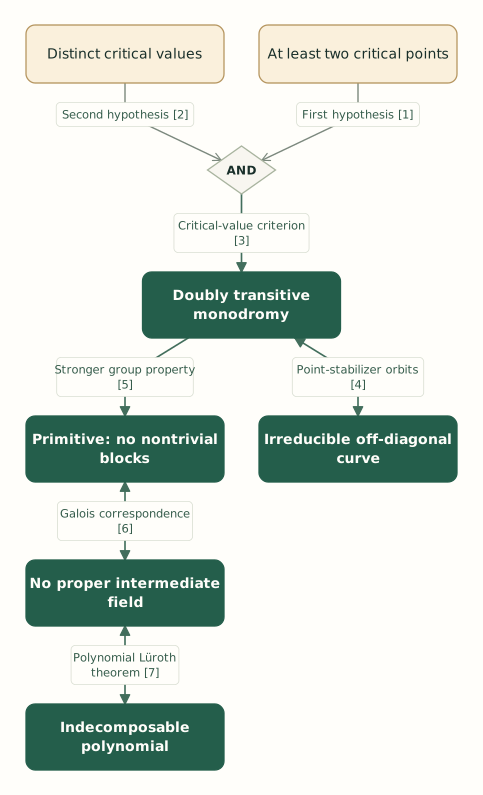
→ deduction or information flow↔ equivalenceAND joint hypotheses
Write , identifying right components up to postcomposition by an invertible affine polynomial. These components correspond to the fields , and to blocks containing a chosen root in the monodromy action. A block is a nonempty root subset whose translates are either equal or disjoint. Thus has no decomposition with exactly when is primitive.
The stronger condition is a separate equivalence:
Indeed, the stabilizer of one root must act transitively on all remaining roots. Kreso–Tichy, Proposition 3.8, supplies a sufficient condition: has at least two distinct roots, and for every pair of distinct critical points . Multiple roots of are allowed.
The converse from primitivity to double transitivity fails: is indecomposable, but its geometric monodromy is cyclic of order five and . This example also shows why the condition on the number of critical points cannot be dropped. The coefficient field here is ; arithmetic and geometric monodromy over a nonclosed field require separate treatment.
Inspect all 7 connections and exact references
| Connection | Statement and source |
|---|---|
| 1At least two critical points → ANDConstruction / input | The distinct roots of the derivative include at least two points; no simplicity assumption is imposed. |
| 2Distinct critical values → ANDConstruction / input | Different critical points have different images under the polynomial. |
| 3AND → Doubly transitive monodromyDeduction | Together these hypotheses imply double transitivity by the published Proposition 3.8.
|
| 4Doubly transitive monodromy ↔ Irreducible off-diagonal curveEquivalence | Double transitivity is equivalent to irreducibility of over .
|
| 5Doubly transitive monodromy → Primitive: no nontrivial blocksDeduction | Every doubly transitive permutation group is primitive.
|
| 6Primitive: no nontrivial blocks ↔ No proper intermediate fieldEquivalence | The root stabilizer is maximal exactly when has no proper intermediate field.
|
| 7No proper intermediate field ↔ Indecomposable polynomialEquivalence | A proper intermediate field is for a decomposition with both degrees greater than one.
|
Sources and scope checked .
Ritt’s first theorem
Theorem
Let have degree greater than one. Any two complete decompositions have the same length and the same multiset of degrees. One can pass between them by successive replacements of two adjacent factors by two factors with the same composition.
The theorem gives a controlled form of nonuniqueness. It does not say that the factors themselves are uniquely determined. At the field level, a complete decomposition is a maximal chain of intermediate fields. The proof uses the cyclic inertia group above infinity to compare these chains.
References 2
- Ritt1922 · Main decomposition theorem, pp. 51–66; erratum, p. 431Source
- ZieveMueller2008 · Theorem 2.1 and Corollary 2.12Source
Ritt’s second theorem
Over , suppose with all four polynomials nonconstant and
Up to linear changes and exchanging the two decompositions, Ritt’s second theorem reduces the identity to one of two forms:
Here , , and is a Chebyshev polynomial, characterized by . The displayed identities explain the basic changes between decompositions; the coprimality assumptions belong to the classification.
References 2
- Ritt1922 · Classification of composition identities; erratum, p. 431Source
- ZieveMueller2008 · Theorem 2.17Source
Example
The degree-six polynomial has two complete decompositions:
Indeed, both sides expand to . The degree sequences are and . Every component is indecomposable: its degree is prime, whereas a nontrivial composition has composite degree. This is the monomial case of Ritt’s second theorem with , , and .
References 1
- ZieveMueller2008 · Theorem 2.17; the displayed identity is verified by expansionSource
Computing a decomposition
For a proposed factorization , normalize the right factor to be monic with zero constant term. Comparing the leading coefficients of then determines successive coefficients of , provided the characteristic does not divide the outer degree . One finally checks the exact identity .
Von zur Gathen gives algorithms and uniqueness results in this tame case. When the characteristic divides , the coefficient equations lose information, and different methods are needed. The two papers on tame and wild decomposition treat these cases separately.
References 2
- VonZurGathen1990Tame · §§2–3, univariate decompositionSource
- VonZurGathen1990Wild · Introduction and decomposition algorithmSource
Further connections
Composition also constrains the factorization of . For example, a common left factor , with , gives a factor of . The article on separated variables studies this problem and its connection with monodromy.
The repeated composition gives nested block partitions, according to the common ancestors of roots in the preimage tree. The Galois group therefore embeds in an iterated wreath product, even when is irreducible.
References 2
- Odoni1985 · Composites and iteratesSource
- BehajainaKonigNeftin2026DLS · Introduction; arXiv:2603.27728v1, preprintSource
Related topics
Connected diagrams
- Morse geometry and Hilbert specialization require two different inputs · Classical
- A complete proposed classification of reducible f(X) − g(Y) · Claimed
Composition and iteration
Introduction to composition and iteration.
RelatedTransitivity, primitivity, and cycle criteria
Blocks and primitive actions.
RelatedArboreal Galois groups
Repeated composition produces a tree of blocks.
RelatedPolynomials with separated variables
Reducibility of f(X)−g(Y).
RelatedCritical points and polynomial monodromy
Branch points and monodromy.
References
- Prime and composite polynomials
Ritt, Joseph F. Transactions of the American Mathematical Society, 23(1), 51–66, 1922.
Read the source - On Ritt's polynomial decomposition theorems
Zieve, Michael E. and Müller, Peter. arXiv preprint, 2008.
Read the source - Primitive monodromy groups of polynomials
Müller, Peter. Recent Developments in the Inverse Galois Problem, American Mathematical Society, Contemporary Mathematics, 186, 385–401, 1995.
Read the source - Functional Decomposition of Polynomials: The Tame Case
von zur Gathen, Joachim. Journal of Symbolic Computation, 9(3), 281–299, 1990.
Read the source - Functional Decomposition of Polynomials: The Wild Case
von zur Gathen, Joachim. Journal of Symbolic Computation, 10(5), 437–452, 1990.
Read the source - The Galois Theory of Iterates and Composites of Polynomials
Odoni, R. W. K. Proceedings of the London Mathematical Society (3), 51(3), 385–414, 1985.
Read the source - The Davenport–Lewis–Schinzel problem on the reducibility of f(X)−g(Y)
Behajaina, Angelot and König, Joachim and Neftin, Danny. arXiv, 2026.
Read the source - Diophantine equations in separated variables
Kreso, Dijana and Tichy, Robert F. Periodica Mathematica Hungarica, 76, 47–67, 2018.
Read the source
Comments
Any comments are welcome. Comments appear after the site owner approves them. Privacy policy.