Overview
- When do critical points determine the Galois group of f(x)−T?
- Why do simple critical values give transpositions?
- Why is the generic group symmetric for xⁿ−x−T?
- How can the group change after specialization?
Morse polynomials
Let have characteristic zero and let have degree . A critical point is a root of ; its critical value is . The polynomial is called Morse if it has distinct critical points and their critical values are pairwise distinct.
Both conditions matter. For , the critical points are simple, but . Moreover, is a composition of two quadratic polynomials. This decomposition gives a block system on the four roots of .
The geometric Galois group is taken over ; the arithmetic Galois group is taken over . The theorem below determines both.
References 1
- Serre2007Topics · §4.4, Theorems 4.4.1 and 4.4.5, pp. 39–41Morse hypotheses and the geometric construction; the quartic boundary example is computed here.Source
The Morse criterion
Theorem
If is Morse and , then the geometric and arithmetic Galois groups of are both , where . Its splitting field over is regular over .
Once the geometric group is , the arithmetic assertion follows: it contains the geometric group and is itself a subgroup of . Equality of the groups means that the splitting field introduces no new algebraic constants.
References 1
- Serre2007Topics · Theorems 4.4.1 and 4.4.5The general theorem is applied after base change to the algebraic closure; arithmetic equality and regularity follow.Source
Proof
Work over . By Gauss’s lemma, a factorization of over would give one in . Its degree in is one, so one factor is independent of . That factor divides the coefficient of , and is therefore a unit. Thus is irreducible over , and its group is transitive.
At a simple critical point , the expansion has the form , with . The ramification index at is two. Since no other critical point has value , all other points of this fiber are unramified. An inertia generator therefore exchanges exactly two roots and fixes the rest: it is a transposition.
Let be the normal subgroup generated by inertia at the finite branch values. The quotient of the Galois closure by is a connected degree- cover of , unramified except possibly at infinity. If points lie above infinity, Riemann–Hurwitz gives
Since and , we get . Thus : the transpositions generate the whole group.
Make a graph whose vertices are the roots and whose edges are the generating transpositions. Transitivity says that this graph is connected. Edge transpositions of a connected graph generate , so .
References 1
- Serre2007Topics · Theorem 4.4.5 and Proposition 4.4.6, p. 41Inertia generation via Riemann–Hurwitz. The graph argument expands the transposition step.Source
Connections and evidence
ClassicalMorse geometry and Hilbert specialization require two different inputs
Simple critical points and distinct critical values yield regular -monodromy; the Hilbert property then supplies infinitely many specializations with the same group.
Scope. Let be a number field, monic of degree , and transcendental. Critical points are taken over .
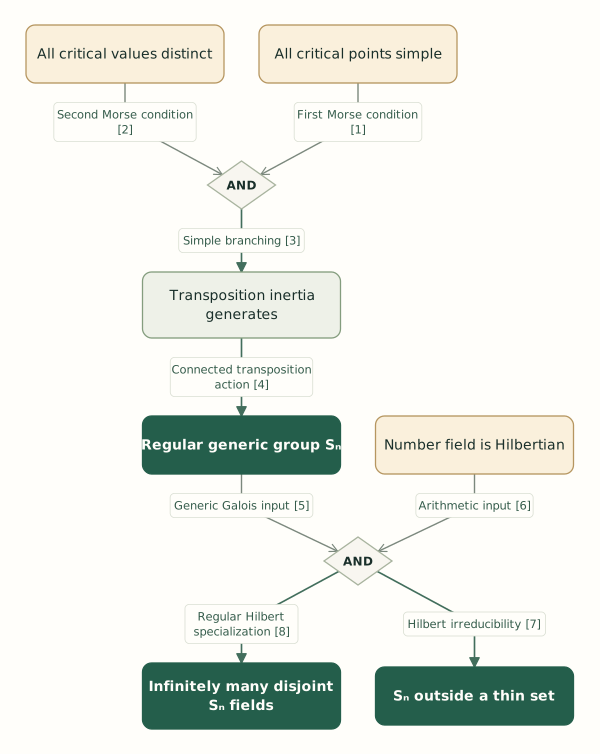
→ deduction or information flowAND joint hypotheses
A polynomial is Morse when the roots of are simple and have pairwise distinct images. Under the displayed assumptions, the splitting field of satisfies
The proof first works geometrically. Each finite branch point contributes a transposition, and these inertia groups and their conjugates generate the transitive monodromy group. Hence that group is . Arithmetic monodromy lies between geometric monodromy and , so they coincide and regularity follows.
Hilbert irreducibility adds a different input: because is a number field, there is a thin set such that every gives an irreducible with group . Regularity further permits infinitely many splitting fields that are linearly disjoint. These conclusions concern suitable specializations; the exceptional set need not be finite.
For example, is Morse. At , its fiber splits completely; at , is irreducible by the rational-root test and has nonsquare discriminant , so its group is . The two fibers illustrate why a generic monodromy theorem alone does not certify a chosen arithmetic fiber.
Inspect all 8 connections and exact references
| Connection | Statement and source |
|---|---|
| 1All critical points simple → ANDConstruction / input | The derivative has exactly distinct roots over . |
| 2All critical values distinct → ANDConstruction / input | The images of those critical points are pairwise distinct. |
| 3AND → Transposition inertia generatesDeduction | Each finite branch inertia group is generated by a transposition, and their conjugates generate geometric monodromy.
|
| 4Transposition inertia generates → Regular generic group SₙDeduction | The polynomial cover is transitive, so generation by transpositions yields geometric and arithmetic group , with constant field .
|
| 5Regular generic group Sₙ → ANDConstruction / input | The splitting field is regular over the coefficient field and has full symmetric group. |
| 6Number field is Hilbertian → ANDConstruction / input | The affine line over a number field has the Hilbert property.
|
| 7AND → Sₙ outside a thin setDeduction | Outside a thin subset of , the polynomial is irreducible with Galois group .
|
| 8AND → Infinitely many disjoint Sₙ fieldsDeduction | Regularity and the Hilbert property jointly allow specializations linearly disjoint from any prescribed finite extension, and hence infinitely many linearly disjoint splitting fields.
|
Sources and scope checked .
Example
Take , with . Its critical points satisfy , so they are nonzero and distinct. At such a point,
The critical values are therefore distinct. The Morse criterion gives group for in characteristic zero. Over , Hilbert irreducibility then gives infinitely many rational for which also has group .
References 1
- Serre2007Topics · §4.4 and §3.3The Morse theorem and specialization framework; the derivative calculation is supplied here.Source
Specializations of a cubic
For , the critical points are , with values . Thus has generic group . Its discriminant is
Examples over
- : is reducible; its splitting-field group is , fixing the rational root.
- : has no rational root and discriminant , so its group is .
- : has a repeated root. This is a branch value, outside the separable-fiber setting.
- : is Eisenstein at , and its discriminant is , a nonsquare. Its group is .
References 2
- ConradCubicQuartic · Equation (1.1) and Theorem 2.1Cubic discriminant formula and the irreducible cubic group test; specialized identities are checked directly.Source
- Serre2007Topics · §4.4The generic Morse theorem.Source
Positive characteristic
In characteristic , the polynomial has derivative . The cover is unramified at finite points and has geometric group , acting by for . It is wildly ramified at infinity, so the tame Riemann–Hurwitz calculation in the proof does not apply. Positive-characteristic versions of the Morse criterion require separate hypotheses.
References 1
- Serre2007Topics · Theorem 4.4.5; remark after Corollary 4.4.7, pp. 41–42Positive-characteristic scope and the Artin–Schreier boundary.Source
Questions
Do separable specializations retain the generic group?
Scope. The characteristic-zero Morse family X³−3X−T over Q
No. At the polynomial is reducible, and at it is irreducible with group . Both fibers are separable. Hilbert irreducibility gives many full-group fibers, with possible exceptional specializations.
References 1
- Serre2007Topics · §3.3 and §4.4Specialization framework; the two counterexamples are calculated in this article.Source
Related topics
Connected diagrams
Browse all diagrams →Specialization and Hilbert irreducibility
Specialization relates the generic group to the groups of rational fibers.
UsesRamification and inertia
Inertia at a simple branch value is generated by a transposition.
UsesTransitivity, primitivity, and cycle criteria
A transitive group generated by transpositions is symmetric.
Contrasts withComposition and iteration
Composition gives intermediate covers and block systems; critical values can coincide as a result.
Constructs examples forInverse Galois theory and generic polynomials
The family X^n−X−T gives regular symmetric-group extensions of Q(T).
DevelopsBranched covers and rigidity
Branch cycles and rigidity extend the connection between ramification and Galois groups.
References
- Topics in Galois Theory
Serre, Jean-Pierre. Edition 2. A K Peters/CRC Press, Research Notes in Mathematics 1, 2007.
Read the source - Galois groups of cubics and quartics (not in characteristic 2)
Conrad, Keith. Author-hosted expository note.
Read the source
Comments
Any comments are welcome. Comments appear after the site owner approves them. Privacy policy.