Overview
- Why do coprime degrees imply absolute irreducibility of f(x)−g(y)?
- When is a sum of three nonconstant univariate polynomials irreducible?
- What is known about the classification of reducible pairs f(x)−g(y)?
Coprime degrees
Theorem
Let be nonconstant, of degrees . If , then is absolutely irreducible. The field may have any characteristic.
Work over with the valuation . As a polynomial in , has constant coefficient of valuation , leading coefficient of valuation zero, and all intermediate nonzero coefficients of valuation zero. Its lower Newton polygon is one segment from to . Since its slope is in lowest terms, the degree in of every nonconstant factor is divisible by . The polynomial is therefore irreducible over . Its leading coefficient is constant, so Gauss’s lemma gives absolute irreducibility in two variables.
For example, is absolutely irreducible over every field. When the degrees have a common divisor, this argument is inconclusive: factors, whereas is absolutely irreducible in characteristic different from two.
References 1
- PanaitopolStefanescu1990 · Corollary 3; apply the degree-index criterion to f(x)−g(y)Source
A degree criterion
The same proof applies to
Put . If
then is absolutely irreducible. The inequalities place every intermediate valuation point on or above the segment joining and .
Example
The polynomial satisfies the inequalities with : and . It is absolutely irreducible in every characteristic.
References 1
- PanaitopolStefanescu1990 · Proposition 2 and Corollary 3Source
Sums in three or more variables
Theorem (Tverberg)
Let have characteristic zero, let , and let each be nonconstant. Then is absolutely irreducible.
No coprimality condition on the degrees is required. For instance, is absolutely irreducible over . The characteristic assumption cannot be dropped: in characteristic , .
Tverberg also studied the positive-characteristic exceptions for three variables. Singh and Khanduja extended this work to any number of variables at least three. Their result concerns additive-polynomial obstructions.
References 3
- Schinzel2000 · §1.7, Corollaries 2–3Source
- Tverberg1966 · pp. 364–366Source
- SinghKhanduja2004 · Introduction and main theoremSource
Critical values
For , the roots of are the negatives of the critical values of . They record where the roots merge as the value of the polynomial changes.
A criterion of Davenport–Lewis–Schinzel, stated as Theorem A by Brindza–Pintér, is the following. For , if , , and at least distinct roots of are not roots of , then is irreducible over . Brindza–Pintér apply the criterion to products of consecutive linear factors.
This uses the positions of branch values, rather than only the degrees. The associated monodromy actions explain why two polynomials with equal degrees can behave quite differently.
References 2
- DavenportLewisSchinzel1961Source
- BrindzaPinter1997 · p. 303, Theorem ASource
Composition and reducible pairs
A common left composition factor gives a direct factorization. If , , and , then divides , because divides . Both resulting factors are nonconstant.
There are also exceptional pairs without a common left factor. Cassou-Noguès and Couveignes give explicit families in degrees , linked to different permutation actions of the same monodromy group.
Claimed in a 2026 preprint. Behajaina–König–Neftin’s Theorem 1.1 classifies all reducible pairs over : they arise from a common left factor, the listed exceptional pairs, or the Chebyshev pair , with , by the compositions specified in the theorem.
Here . In terms of the convention used in polynomial decomposition, one has . The preprint writes for our .
Example
Multiplication proves this identity directly, independently of the claimed classification.
References 2
- CassouNoguesCouveignes1999 · §5Source
- BehajainaKonigNeftin2026DLS · Theorem 1.1, arXiv v1 (29 March 2026)Source
Connections and evidence
Claimed · preprintA complete proposed classification of reducible f(X) − g(Y)
The 2026 DLS preprint claims an if-and-only-if classification over , including decomposable polynomials: common outer factors, the exact six exceptional families, or the signed quartic Chebyshev pair.
Scope. Let have degree greater than one. The classification is Theorem 1.1 of arXiv:2603.27728v1 (29 March 2026), recorded as a preprint claim.
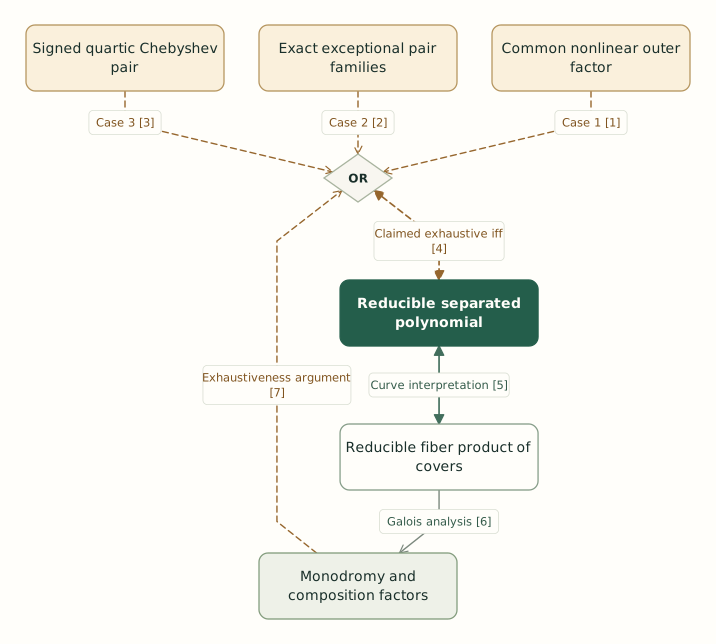
→ deduction or information flow↔ equivalence preprint claimOR alternatives
Preprint claim, exact scope. Behajaina–König–Neftin, Theorem 1.1, states that is reducible over exactly when at least one of the following occurs. All inner polynomials are nonconstant; has .
- and , with .
- and , for an exact exceptional pair in Cassou–Noguès–Couveignes, §5.
- and , with .
Case 2 refers to the coefficient formulas, parameter families, and coefficient conjugations in the following source locations; the degrees alone are not a criterion.
| Degree | Exact exceptional family |
|---|---|
| 7 | §5.1, p. 310 |
| 11 | §5.2, p. 310 |
| 13 | §5.3, p. 311 |
| 15 | §5.4, pp. 311–312 |
| 21 | §5.5, pp. 312–313 |
| 31 | §5.6, pp. 313–315 |
The normalization satisfies . Case 3 is visible directly:
The claimed advance is exhaustiveness for arbitrary decomposable pairs. It does not by itself classify reducible arithmetic fibers , whose Hilbert–Siegel analysis is a separate, more restricted result.
Inspect all 7 connections and exact references
| Connection | Statement and source |
|---|---|
| 1Common nonlinear outer factor → ORConstruction / input · preprint | There exist nonconstant and of degree at least two with and .
|
| 2Exact exceptional pair families → ORConstruction / input · preprint | There are nonconstant , affine , and an exact pair from Cassou–Noguès–Couveignes §5 with , .
|
| 3Signed quartic Chebyshev pair → ORConstruction / input · preprint | There are nonconstant and affine with , , where .
|
| 4OR ↔ Reducible separated polynomialEquivalence · preprint | The preprint asserts that the union of the three displayed cases is necessary and sufficient for reducibility over the complex numbers.
|
| 5Reducible separated polynomial ↔ Reducible fiber product of coversEquivalence | Reducibility of the separated polynomial is equivalent to reducibility of the fiber product of the two polynomial maps to the projective line.
|
| 6Reducible fiber product of covers → Monodromy and composition factorsConstruction / input | The proof translates the fiber product into monodromy actions and studies kernels along polynomial decompositions.
|
| 7Monodromy and composition factors → ORConstruction / input · preprint | The preprint combines its solvable-case analysis with the established exceptional pairs to rule out additional minimal cases.
|
Sources and scope checked .
Questions
Which pairs f(x)−g(y) are reducible over the complex numbers?
Scope. Nonconstant complex polynomials of degree at least two
A full classification is claimed in Behajaina–König–Neftin’s March 2026 preprint, Theorem 1.1. The published exceptional families are described by Cassou-Noguès and Couveignes.
References 2
- BehajainaKonigNeftin2026DLS · Theorem 1.1Source
- CassouNoguesCouveignes1999 · §5Source
Related topics
Connected diagrams
Browse all diagrams →Newton polytopes and irreducibility
A valuation at infinity gives a complementary Newton-polygon test.
Related toPolynomial decomposition
Common composition factors account for many reducible pairs.
Related toCritical points and polynomial monodromy
Branch values and permutation actions describe separated-variable curves.
Related toPolynomial fibers and Bertini’s theorem
The curves f(x)=g(y) are fiber products of polynomial maps.
Linked from 3 articles
References
- On the generalized difference polynomials
Panaitopol, Laurenţiu and Ştefănescu, Doru. Pacific Journal of Mathematics, 143(2), 341–348, 1990.
Read the source - Polynomials with Special Regard to Reducibility
Schinzel, Andrzej. Cambridge University Press, Encyclopedia of Mathematics and its Applications, vol. 77, 2000.
Read the source - On the irreducibility of polynomials f(x)+g(y)+h(z)
Tverberg, Helge. The Quarterly Journal of Mathematics, 17(1), 364–366, 1966.
Read the source - An Extension of the Irreducibility Criteria of Ehrenfeucht and Tverberg
Singh, Amrit Pal and Khanduja, Sudesh K. Communications in Algebra, 32(2), 579–588, 2004.
Read the source - Equations of the form f(x)=g(y)
Davenport, Harold and Lewis, Donald J. and Schinzel, Andrzej. The Quarterly Journal of Mathematics, 12(1), 304–312, 1961.
Read the source - On the irreducibility of some polynomials in two variables
Brindza, Béla and Pintér, Ákos. Acta Arithmetica, 82(3), 303–307, 1997.
Read the source - Factorisations explicites de g(y)−h(z)
Cassou-Noguès, Pierrette and Couveignes, Jean-Marc. Acta Arithmetica, 87(4), 291–317, 1999.
Read the source - The Davenport–Lewis–Schinzel problem on the reducibility of f(X)−g(Y)
Behajaina, Angelot and König, Joachim and Neftin, Danny. arXiv, 2026.
Read the source
Comments
Any comments are welcome. Comments appear after the site owner approves them. Privacy policy.