Overview
- Why does reversing one factor preserve PP*?
- Why is the resulting polynomial still binary?
- Which exceptional factors must be treated separately?
The binary model
Let
with independent .
Preprint theorem · Kogler, v2, 14 October 2026
Theorem 1.1 states the unconditional asymptotic
The leading contribution comes from the factor . The theorem concerns reducibility in this binary model. The Galois group and the fair-sign model are separate questions.
References 1
- Kogler2026 · Theorem 1.1, v2Exact model, asymptotic and preprint status.Source
The reciprocal product
For a polynomial with nonzero constant term, let . Suppose a binary polynomial with leading and constant coefficients factors as , with monic. Put . Then
Then also has coefficients in , with leading and constant coefficients one.
Proof
The identity follows because reversal is multiplicative and involutive on polynomials with nonzero constant term.
Write and . The central coefficient of the identity gives . Reversal preserves evaluation at , so . Since ,
Each summand is a nonnegative integer. Thus each equals or , and its leading and constant coefficients equal .
A factorization with neither factor reciprocal gives . Thus one bounds such pairs , and treats reciprocal factors separately.
References 3
- Ljunggren1960An antecedent of factor-reversal arguments.Source
- filaseta1999smallnormThe Euclidean-norm perspective on factorization.Source
- Kogler2026 · Lemma 3.1The binary twin-factorization step.Source
Example
Let and . The supports of and are
In each product, the shifted copies of have disjoint supports, so the coefficients are binary. The reciprocal products agree. Yet and , since the support of is .
Thus the autocorrelation encoded by can agree for binary polynomials that are distinct even up to reversal.
The congruence estimate
Kogler’s Theorem 1.3 bounds the probability of a nontrivial binary twin even when equality of reciprocal products is replaced by congruence modulo . Reduction modulo restricts the possible factors, and the congruence imposes further conditions on opposite coefficient pairs. Cyclotomic factors and reciprocal noncyclotomic factors are treated separately.
The factor-reversal identity also applies in deterministic arguments, including those for polynomials with large gaps.
References 2
- Kogler2026 · Theorem 1.3 and §3, v2Probabilistic collision estimate and exceptional factors.Source
- sawinshustermanstoll2020Related deterministic use of Ljunggren-type ideas.Source
Connections and evidence
Claimed · preprintBinary factorization, Fourier ambiguity, and irreducibility
Factor reversal converts two nonreciprocal factors into a second binary signal with identical Fourier magnitude. A collision bound and two separate divisor estimates give the claimed reducibility asymptotic.
Scope. , with independent fair , over ; . Fourier comparisons use binary polynomials of the same degree with both endpoints equal to one.
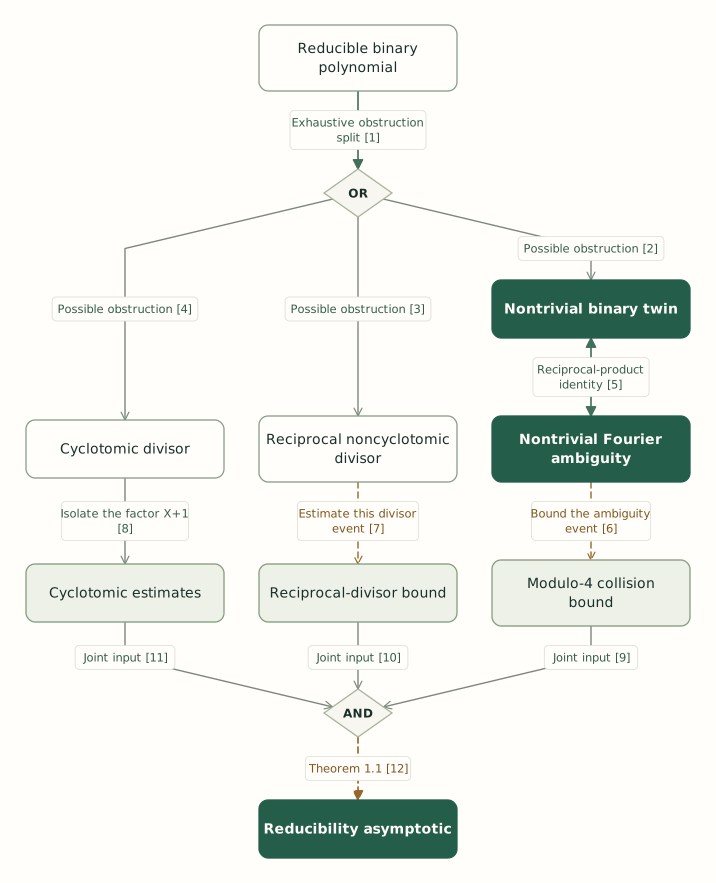
→ deduction or information flow↔ equivalence preprint claimAND joint hypothesesOR alternatives
Let , and choose uniformly. Write . If with monic nonconstant integer factors, then is binary and ; it differs from both and exactly when neither factor is reciprocal. On the unit circle, .
Preprint claim, Kogler v2. Theorem 1.3 states
This also bounds nontrivial exact Fourier-magnitude ambiguity. It does not alone control every reducibility event: reciprocal noncyclotomic divisors require Proposition 3.2, while cyclotomic divisors require separate estimates. Reducibility is contained in the union of the three displayed obstruction events.
The reciprocal-divisor probability is at most for sufficiently large . Cyclotomic factors of degree at least two have probability . Since , the only remaining linear factor is . Its probability is . Together these estimates give Theorem 1.1:
The conclusion concerns irreducibility in the binary coefficient model. Galois-group conclusions and other coefficient laws require separate theorems.
Inspect all 12 connections and exact references
| Connection | Statement and source |
|---|---|
| 1Reducible binary polynomial → ORDeduction | Every reducible polynomial in this model has a nontrivial binary twin or a nonconstant reciprocal divisor; the latter is cyclotomic or has a noncyclotomic factor.
|
| 2OR → Nontrivial binary twinConstruction / input | This branch records a possible obstruction, not a conclusion implied separately by reducibility. |
| 3OR → Reciprocal noncyclotomic divisorConstruction / input | This branch records a reciprocal divisor which is not a product of cyclotomic polynomials. |
| 4OR → Cyclotomic divisorConstruction / input | This branch records a cyclotomic divisor; the three obstruction events need not be disjoint. |
| 5Nontrivial binary twin ↔ Nontrivial Fourier ambiguityEquivalence | For binary P and Q of the same degree with Q distinct from P and P*, the identity PP*=QQ* is equivalent to equality of their Fourier magnitudes at every angle.
|
| 6Nontrivial Fourier ambiguity → Modulo-4 collision boundConstruction / input · preprint | Exact reciprocal-product equality is included in congruence modulo four, whose nontrivial collision probability is bounded in Theorem 1.3.
|
| 7Reciprocal noncyclotomic divisor → Reciprocal-divisor boundConstruction / input · preprint | Proposition 3.2 bounds the probability of a monic reciprocal divisor that is not a product of cyclotomic polynomials.
|
| 8Cyclotomic divisor → Cyclotomic estimatesConstruction / input | The factor X-1 is impossible, higher-degree cyclotomic divisors contribute O(1/n), and X+1 supplies the leading term.
|
| 9Modulo-4 collision bound → ANDConstruction / input | Use the collision estimate together with both divisor estimates. |
| 10Reciprocal-divisor bound → ANDConstruction / input | Use the reciprocal-divisor estimate together with the collision and cyclotomic estimates. |
| 11Cyclotomic estimates → ANDConstruction / input | Use both the upper bound for other cyclotomic factors and the exact probability that P_n(-1)=0. |
| 12AND → Reducibility asymptoticDeduction · preprint | The union bound gives the upper estimate, while divisibility by X+1 for n≥2 gives the matching leading lower estimate.
|
Sources and scope checked .
Questions
Does the binary model have full symmetric group with probability tending to one?
Scope. Monic binary polynomials over Q with constant term 1 and independent fair internal coefficients.
The cited preprint states a high-probability irreducibility theorem. A full- theorem also requires control of the transitive group and the discriminant square class.
References 1
- Kogler2026 · Theorem 1.1Scope of the cited result.Source
Related topics
Sparse polynomials and factor reversal
Deterministic large-gap arguments also use reversal and norm identities.
UsesReciprocal polynomials
The same reversal defines reciprocal polynomials.
Contrasts withLittlewood polynomials
Reduction of sign coefficients modulo two is deterministic.
Supplies examples forRandom polynomials: models and methods
The binary proof uses a reciprocal-product congruence.
Linked from 2 articles
References
- The Odlyzko-Poonen Conjecture on Irreducibility of Random Polynomials
Kogler, Constantin. 2026.
Read the source - On the irreducibility of certain trinomials and quadrinomials
Ljunggren, Wilhelm. Mathematica Scandinavica, 8, 65–70, 1960.
Read the source - On the factorization of polynomials with small Euclidean norm
Filaseta, Michael. Number Theory in Progress, Vol. 1, de Gruyter, 143–163, 1999.
Read the source - Irreducibility of polynomials with a large gap
Sawin, Will and Shusterman, Mark and Stoll, Michael. Acta Arithmetica, 192(2), 111–139, 2020.
Read the source - Irreducibility of random polynomials of large degree
Breuillard, Emmanuel and Varjú, Péter P. Acta Mathematica, 223(2), 195–249, 2019.
Read the source
Comments
Any comments are welcome. Comments appear after the site owner approves them. Privacy policy.